One in retreat, three moving forward.
2025 China’s bricks-and-mortar grocery sector traced a rare bifurcation: hypermarkets kept closing, membership stores expanded fast, new-retail turned a full-year profit for the first time, and the domestic incumbent rebuilt itself in the Pang Dong Lai mould. Walmart China’s hypermarkets shrank to 283 stores, while Sam’s Club opened ten new stores in the same year and broke ¥14B; Hema’s GMV reached ¥75B and turned its first full-year adjusted EBITA positive; Yonghui completed 222 “Pang Dong Lai remodels” and shut 381 other stores. This is not a “retail slump” story — it is a systemic re-stacking across positioning, supply chain, and organisation. Where each chain ends up determines its per-store output for the next decade.
§01 · Overview — four chains, four paths
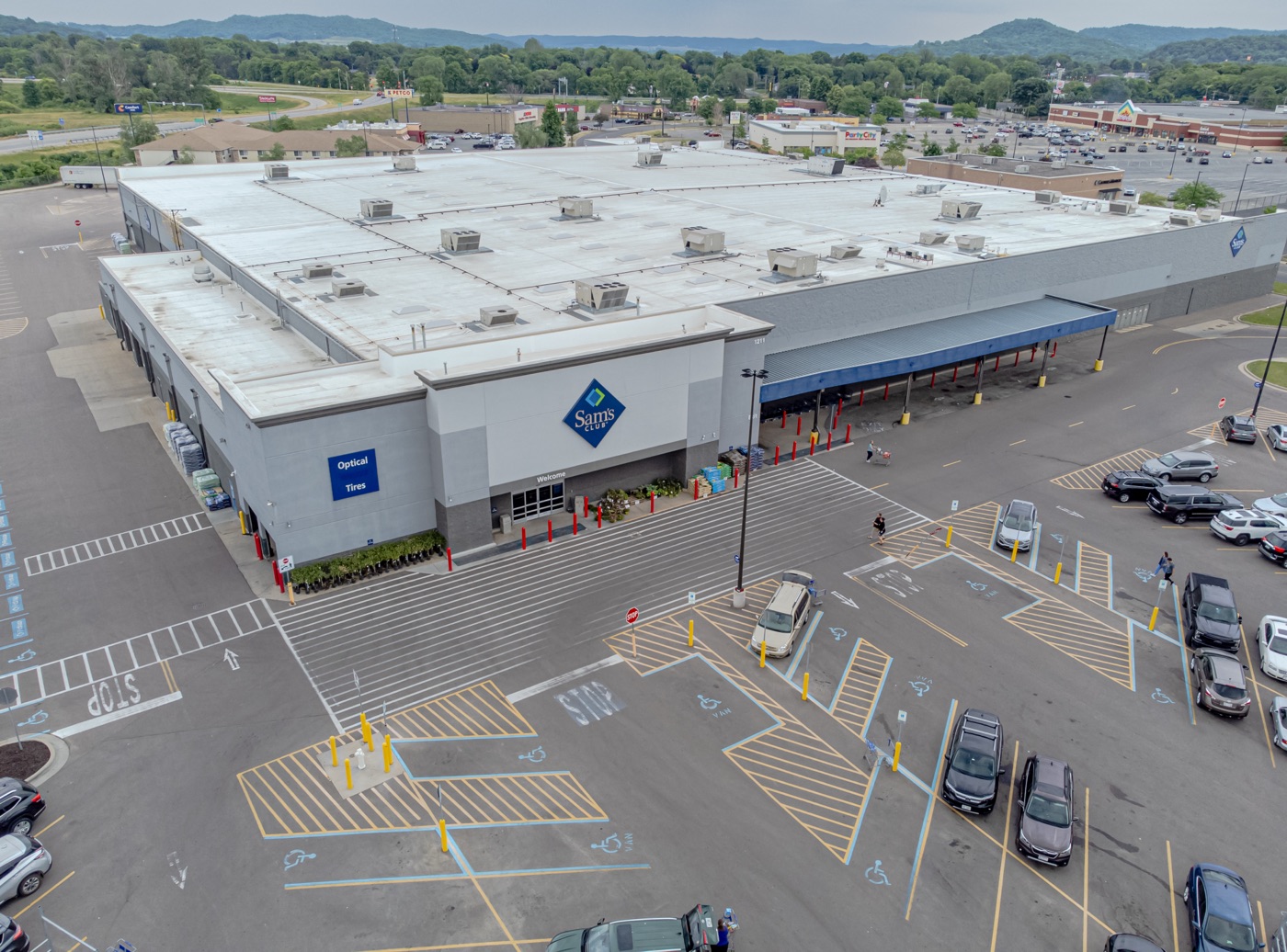
Image: Wikimedia Commons / CC BY-SA 4.0.
If you compress 2025 China grocery into one line: “sell more” is being replaced by “sell better”. The decade-old playbook of scale expansion and price-driven volume in hypermarkets has given way to three parallel models — membership filtering (Sam’s Club), store-as-warehouse plus private label (Hema), and selection / staff / service (Pang Dong Lai). Yonghui chose to retool toward path three; Walmart China chose to vacate the old main lane and concentrate fire on Sam’s Club.
The per-store output gap states the issue plainly: Sam’s Club averages ¥2.2B+ per store per year, while pre-remodel Yonghui sat at only ¥85M. Same cities, same population — efficiency differs by more than 25×.
| Chain | 2025 figure | YoY | Notes |
|---|---|---|---|
| Walmart China Q3 | $6.1B | +21.8% | Hypermarkets ~283 · Sam’s 61–63 |
| Sam’s China 2025 | ¥140B+ | +40% | Paid members ~10.7M |
| Hema FY25 GMV | ¥75B | First annual profit | 420+ Fresh · Private label 50% |
| Yonghui 2024 revenue | ¥67.6B | −14.1% | 4-yr cumulative loss ¥9.5B |
Winners win on filtering, supply chain, and service — not on store count.
Sam’s Club hands the “who gets in” question to a ¥260/¥680 fee; Hema runs a working margin engine on store-as-warehouse plus private label; the Pang Dong Lai model converts “selection × staff × service” into a replicable SOP. The shared trait of all three: moving complexity from the sales floor back into the supply chain, trading institutional rigour for per-store efficiency. Yonghui is learning this; Walmart China is abandoning the old playbook and going all-in on Sam’s Club.
§02 · Walmart China — hypermarket retreat + community-store pilot
Walmart China’s 2025 logic is “close the old, open the new”: continued contraction in legacy hypermarkets, a community-store pilot, and growth concentrated entirely in Sam’s Club. After three decades of localisation, the foreign incumbent is repositioning itself.
FY26 Q3 Walmart China revenue was $6.1B (+21.8%), but that figure already absorbs Sam’s Club’s rapid growth. The traditional Walmart hypermarket count has shrunk from a 400+ peak to ~283; Sam’s Club has continued adding stores to 61–63. Two reverse curves inside the same company.
Two formats, two logics
- Hypermarkets · from “expansion” to “curation + exit”. The previous-generation hypermarket model — 5,000+ SKUs and price-driven volume — has spent five years squeezed by online fresh delivery, membership clubs, and discount stores, with per-store productivity declining throughout. Walmart’s response: shut the chronically unprofitable boxes and “curate-up” the survivors — compressing SKUs to ~3,000, deepening private label, and reinforcing direct sourcing. 2025: net 30+ closes/remodels · transition toward a “selected store”.
- Community stores · a 500-sqm experiment. In late 2025 Walmart China began piloting a community-store format: 500 sqm, 2,000 SKUs, anchored on high-frequency fresh and daily essentials. The slot it fills sits between hypermarket and convenience store — a 1.5–2 km radius, dense foot-traffic, and a regionally tunable assortment. The plan is 500 stores over the next five to seven years. Big stores out, small stores in · fresh as the anchor.
- Sam’s Club · the real profit engine. Sam’s Club’s role inside Walmart China is increasingly clear: profit pool, growth engine, and membership network. 2025 sales of ¥14B+, membership fees of ¥2.2B+, and 10.7M paid members. This is a clean “membership filter + high per-store output” model (see §03). “Sam’s makes the money, hypermarkets hold the line”.
- Online · penetration > 50%. Walmart’s global e-commerce mix sits at ~17%. Walmart China’s online penetration tops 50% — far above the global average. The reason is China’s mature fresh-delivery infrastructure (Meituan, JD Daojia, Dada), which lets a hypermarket run “store → micro-warehouse → 3 km radius” cleanly. It is the most valuable asset the old hypermarket model leaves behind. “One warehouse, many channels” · fewer stores, higher channel efficiency.
§03 · Sam’s Club — membership filter + ¥2.2B per store
Sam’s Club has done three things right in China: 1) used the membership fee to filter for high-ticket families; 2) built a thick gross margin via deep SKUs and private label; 3) extended its reachable radius to 30–40 km via online “forward warehouse + next-day delivery”. The result: 2025 China sales of ¥14B+, +40% YoY — well ahead of the broader grocery market.
Sam’s Club, in three parameters
| Parameter | Value | What it means |
|---|---|---|
| Paid members | ~10.7M | ¥260/¥680 annual fee · pay-rate is a real-demand filter |
| Membership-fee revenue | ¥2.2B+ | ≈ pure profit · cushions store-level losses |
| Total clubs | 61–63 | 10 new in 2025 · all-time high |
| Average per club | ¥2.2B+ / yr | Top eight clubs exceed ¥3.6B |
| SKUs | ~4,000 | Costco ~4,000 · curated, not exhaustive |
| Private label | ~30%+ | Member’s Mark led · margin anchor |
| 2025 sales | ¥14B+ | +40% YoY · 3× the broader grocery market |
Why membership-club retail finally clicked in China
Costco entered China in 2014 and opened its first store in 2019; Sam’s Club entered back in 1996 and was lukewarm for years. The pivot came around 2020 — middle-class consumption upgrade + e-commerce price wars exposing the “cheap trap” + COVID making bulk-pack stockpiling a necessity. The three structural barriers all loosened simultaneously. Sam’s Club leveraged 25 years of in-China supply-chain build-out to deliver “localised assortment + forward warehouse + hero-product cultivation” first.
Phenomenon-tier SKUs like mochi, Swiss rolls, and rotisserie chicken can do ¥1B+ per single product per year — a result a traditional hypermarket effectively cannot reach. The mechanism behind it is “deep supplier lock-in + exclusive formulation + a small SKU pool”.
Caveat · Sam’s Club is not a silver bullet either.
In Q3–Q4 2025 a “selection-quality slipping” controversy hit social media, with Reddit and Xiaohongshu carrying “Sam’s is becoming ordinary” complaints. The root cause is supply-chain compromise under high-growth pressure — hero products need volume, but volume itself erodes the membership-club premium feel. Holding the “filter + premium” value at a ¥14B run-rate is the single biggest product challenge for 2026.
§04 · Hema — ten years of new retail · first full-year profit
The first store opened in 2016; the first full-year adjusted EBITA only turned positive in 2025 — Hema took ten years to prove that “new retail” can make money, and it required two course-corrections to get there.
Two course-corrections in ten years
- First correction (2022–2023). Hema once ran eight sub-formats — Fresh, Mini, F2, Neighborhood, X-Membership, Boxgo, Hema Mall, and Hema Station. The result was operational sprawl with no single profitable format. In 2022–2023 Hema cut ruthlessly, killing Neighborhood, Mini, Boxgo, and X-Membership, and kept only the two main lines: Fresh + Outlet (discount). Eight half-baked formats compressed into two finished ones.
- Second correction (2024–2025). From “fast expansion” to “model-validation + profit-first”. Specifically: 1) raise private label to 50% (Fresh) / 60%+ (Outlet); 2) global direct sourcing — 35% of purchasing accounts for 60% of sales; 3) re-activate forward warehouses to guarantee 30-minute delivery. 2024 GMV reached ~¥75B and the company posted its first full-year profit. Selection · warehouse · delivery · price — all four pulled together.
- 50% private label is the gross-margin core. Hema Fresh runs ~50% private label, and Hema Outlet runs 60%+ — far above traditional hypermarkets’ 5–10%. Private-label gross margin is typically 10–15pp higher than name-brand, and it is the single variable that lets Hema close the cost gap on its store-plus-online structure. “Daily Fresh” / “Hema brand” — nearly 9 yrs · 10,000+ SKUs.
- Store-as-warehouse · one batch, two channels. A Hema Fresh store is both a 2,000–3,000 sqm experience venue and a fulfilment hub for the surrounding 3 km / 30-minute delivery. One SKU, one batch, serves walk-ins and online orders simultaneously. This lifts effective per-store output to 1.5–2× a traditional supermarket — but demands a sharper replenishment cadence and a stronger IT stack. Online-order share 60%+ · backed by Alibaba logistics.
Key data · FY25
| Metric | Value | Reference |
|---|---|---|
| GMV | ~¥75B | Decade-long buildup · first profit in 2025 |
| Hema Fresh stores | 420+ | 30+ cities covered |
| Hema Outlet (discount) | 400–500 | Rapid expansion through 2024–2025 |
| Per-store (Fresh) | ~¥196M / yr | Between Sam’s Club and Yonghui |
| Private label (Fresh) | ~50% | vs hypermarket 5–10% |
| Private label (Outlet) | 60%+ | Margin anchor · stronger than hard-discount |
| Online-order share | 60%+ | The store-as-warehouse signal |
§05 · Yonghui — Pang Dong Lai remodel · 222 stores in 9 months
Yonghui is the deepest faller and the fastest turner among the four. Revenue dropped from a ¥93.2B 2020 peak to ¥67.6B in 2024 (−14%), with cumulative four-year losses of ¥9.5B. In September 2024 Miniso took a 29.4% stake for ¥6.3B, formally launching the “Pang Dong Lai-isation” remodel.
Pang Dong Lai is a regional supermarket in Xuchang famous for extreme curation, premium staff pay, and meticulous service. Its model does not run on scale, membership, or private label — it converts the toughest-to-standardise piece of retail, “people × service”, into a written SOP. Transplanting that model into Yonghui is what “remodel” means.
The remodel SOP — one store at a time
- Selection · SKUs −30–40% · from “everything” to “curated”. Compress 15,000+ SKUs down to ~10,000; cut the long-tail of slow movers; bring in a slate of Pang Dong Lai-style items (bakery, deli, private label). Post-remodel gross margin lifts 3–4pp.
- Staff · wages +20% · raises + bonuses. Remodel stores raise wages by 20% on average, with some stores up 80%. Bonuses paid Jan–Aug 2025 totalled ¥31M. Trade “labour cost” for “service quality” — the single most contrarian ingredient in the Pang Dong Lai recipe.
- Service · fresh shrink 12% → 7% · standardised down to towel colour. Layout, lighting, sampling, returns, and fresh-merchandising are all standardised. Post-remodel, fresh shrink falls from 12% to 7%, average ticket goes from ¥98 to ¥125, and footfall jumps 80%.
Remodel progress · Q3 2025
Yonghui finished 222 Pang Dong Lai-style remodels in nine months and shut another 381 stores that could not be remodelled — a far faster cadence than the 2–3 years the market initially expected. The closures are leases ending, weak locations, or stores unable to accept the new SOP.
Post-remodel, those 222 stores recovered to ¥120–150M per store per year — 40–75% above the national average of ¥85M. That tells us the Pang Dong Lai model is transferable and scalable — at least in supermarket retail.
Risk · whether the Pang Dong Lai model crosses regions remains an open question.
Pang Dong Lai itself runs only 13 stores in Xuchang and has never been tested across geography, cities, or cultures. Yonghui is effectively running the largest “Pang Dong Lai stress test” in history on its own national network. The 2026 watch-item: can second- and third-tier remodels sustain the first-year footfall, ticket, and margin gains? If yes, this becomes the most important organisational reset in Chinese supermarket retail in 20 years; if not, Yonghui’s ¥6.3B strategic bet returns to square one.
§06 · Compare — four chains, one table
Lined up side-by-side the gap is unmistakable. The biggest gap is not “how many stores” — it is annual sales per store, which is the final output of every operational capability a retailer has.
| Dimension | Walmart hypermarket | Sam’s Club | Hema (Fresh) | Yonghui |
|---|---|---|---|---|
| 2025 per-store annual sales | ~¥100M | ¥2.2B+ | ¥196M | ¥85M / post-remodel ¥120–150M |
| Store count 2025 | ~283 | 61–63 | 420+ Fresh + 400–500 Outlet | 222 remodelled + 381 closed |
| Profit status | Mature, profitable | Strongly profitable | First full-year profit | 4-yr cumulative loss ¥9.5B |
| Membership mechanism | None | 10.7M paid | X-Membership cancelled | None |
| Private label | Emerging | 30%+ | Fresh 50% / Outlet 60%+ | Expanding post-remodel |
| Core logic | Retreat to community + Sam’s | Membership filter + deep SKU | Store-as-warehouse + private label | Pang Dong Lai-isation · selection / staff / service |
| 2026 watch | Community-store rollout | Premium feel vs scale | Net margin + 100 new stores | Remodel replicability |
Three roads that work
- Path 1 · Membership · Sam’s / Costco. A fee + curated SKU filter for high-ticket families. Private label anchors gross margin; per-store output reaches ¥2B+. The cap is “middle-class households × willingness to pay”. Examples: Sam’s Club · Costco · Fudi · M Members’ Club.
- Path 2 · Store-as-Warehouse · Hema. One SKU serves walk-ins and online; private label at 50%+ anchors gross margin while 30-minute delivery anchors repeat purchase. A China-specific retail-infrastructure dividend. Examples: Hema · Xiaoxiang · Pupu.
- Path 3 · Selection × Service · Pang Dong Lai. Standardise “people × service” into a written asset via SOP; do not lean on scale — lean on per-store craftsmanship. Hardest to transfer, highest gross margin; once operational, the moat is deep. Examples: Yonghui (under remodel) · Pang Dong Lai itself.
§07 · Outlook — what to watch in 2026
Grocery is a slow industry, but 2025–2026 is a rare window of structural adjustment — not a cyclical issue, a model issue. Each chain has one indicator it must deliver in the next twelve months.
| Watch | Trigger |
|---|---|
| #1 · Sam’s · premium feel vs scale. Will the late-2025 “Sam’s selection slipping” sentiment spread into actual member churn in 2026? Renewal rate is the most sensitive signal. | Renewal rate < 80% → scale has overtaken premium feel |
| #2 · Hema · 100 new stores. 2026 plans 100 new Fresh stores (50+ cities). On top of first-year profit, will expansion compress margins again? | Per-store output > ¥200M sustained |
| #3 · Yonghui · whole network done. By end-2026 Yonghui must complete the network-wide remodel or close every remaining store. Year-two data on the 222 already-remodelled stores will tell us whether the Pang Dong Lai model holds long term. | Months 13–18 footfall > 70% retained |
| #4 · Walmart · community stores prove out. Can a 500-sqm community store hit ¥30–50M per store per year? That is the second real growth curve outside Sam’s Club. | 50 new stores in 2026 · monthly sales > ¥3M |
Bottom line · 2025 is the inflection year for “scale → quality” in Chinese grocery.
- The hypermarket model is dead — not “adjusted” but “exited”; Walmart’s choice says it all.
- Membership clubs in China only support 2–3 chains — Costco, Sam’s Club, Fudi, M Members’ Club; beyond that and the ceiling kicks in.
- The core of Hema’s edge is Alibaba logistics + private label; without those two pieces of infrastructure, the model is hard to copy.
- The Pang Dong Lai model is the most replicable yet hardest to transfer — Yonghui’s outcome decides whether it becomes a “retail-management case study” or a “retail-management legend”.
- “Sell less, sell better” — not a slogan, the homework all four must hand in during 2026.