A century of cycles, now in its fifth turn.
Commodities are not a single asset but a price barometer for the entire physical economy — metals reflect industrial tempo, energy reflects geopolitics and supply, ag reflects weather and population, precious metals reflect credit and money. Over the past 100 years there have been four to five “super-cycles” — each ignited at the moment structural demand jumped while capex was scarce. This page lays today’s price snapshot, the historical super-cycle rhythm, and three crucial metal/metal × metal/energy ratios on the same table, trying to answer one question: are we at 2003, or at 1974?
§01 · Overview — where we are in the cycle
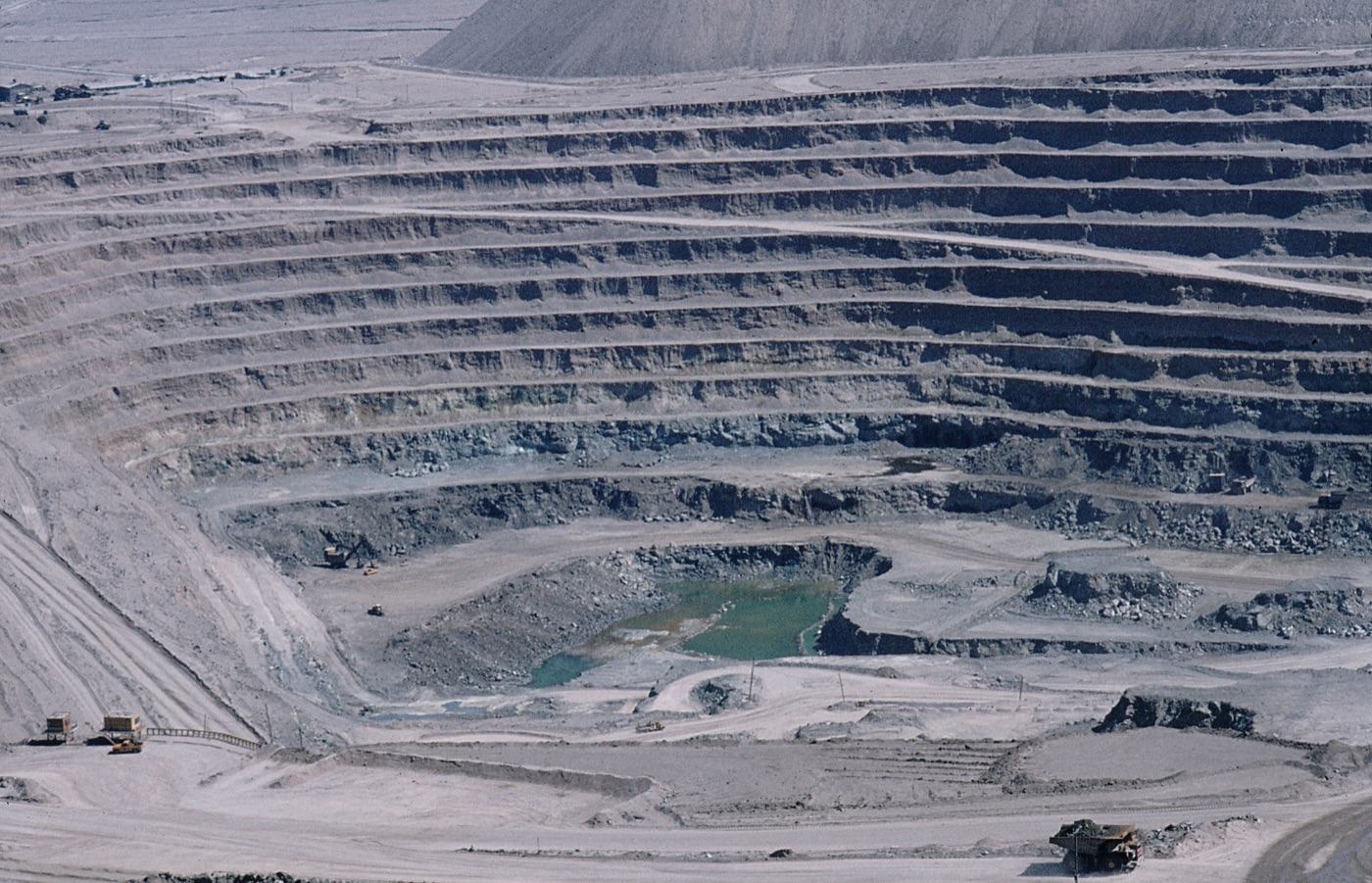
Image: Wikimedia Commons / CC BY-SA 3.0.
The April 2026 commodity complex shows a “three-speed” structure: precious metals are airborne (gold $4,868, silver $79.7, platinum $2,120), industrial metals are diverging (copper $6.07/lb, aluminum +48% YoY, iron ore actually weak), energy is range-bound (WTI $88, Brent $95, Henry Hub $2.8). The Bloomberg Commodity Index is +24.4% YTD — a pretty number on the surface, but more than half the gain comes from precious metals; this is a very uneven bull.
On a 5-10 year horizon, copper is breaking above both the 2011 and 2024 prior highs in a textbook “green transition super-cycle” shape — AI datacenter power, EV electrification and grid upgrades stacking on top of traditional industrial demand. Iron ore, coal and parts of agriculture, on the other hand, show “China-led old cycle” finishing characteristics — China property bottoming, crude steel demand peaking, the coal-supply-security phase ending. Gold/oil, gold/copper and gold/silver point at a rare combination: “monetary/credit anxiety + industrial slowdown + energy geopolitical premium” — in the 20th century only seen in 1974 and 1979.
| Metric | Value | Notes |
|---|---|---|
| COMEX Copper | $6.07 /lb · +30% YoY | ~$12,630/t LME · breaking 2024 high |
| Gold Spot | $4,868 /oz · +51% YoY | April all-time high $4,878 |
| WTI Crude | $88.8 /bbl · +14% YoY | Brent $95 · Hormuz risk premium |
| BCOM Index | ~118 · +24% YTD | Precious metals weight contributes >half |
“Super-cycles do not last a year or two — they last a generation. There will be relays, halvings, and dozens of ‘tops’ that get falsified. The real question isn’t where the top is, but whether the generational demand shift is still going.”
— Paraphrased, on Commodity Super-Cycles
Bottom Line · This isn’t a normal bull market — it’s “super-cycle + safe-haven dual-track resonance.”
Two narratives are pushing BCOM at the same time: the first is physical demand from the green transition — copper, aluminum, lithium, uranium, rare earths; the second is credit discount on the monetary system — gold, silver, platinum. The first is constrained by 5-10 year capex cycles; the second is driven by structural migration of central-bank balance sheets. Read the two threads separately — the allocation implications are very different.
§02 · Current prices — current snapshot across the complex
One table covering energy, industrial metals, precious metals, agriculture and specialty — the YTD and YoY columns let you quickly locate “who’s leading and who’s lagging.” Numbers are approximate; methodology is below the table.
Energy
| Item | Price | Unit | YTD % | 1Y % | 5Y % | Note |
|---|---|---|---|---|---|---|
| WTI Crude | 88.8 | $/bbl | +24% | +15% | +120% | NYMEX CL · Hormuz premium |
| Brent Crude | 95.4 | $/bbl | +28% | +44% | +255% | ICE BR · US-Iran crisis escalation |
| Henry Hub | 2.80 | $/MMBtu | −20% | −15% | −30% | 17-month low · mild winter inventory |
| Thermal Coal | 132 | $/t | +18% | +9% | +120% | Newcastle · geopolitical substitution demand |
Industrial Metals
| Item | Price | Unit | YTD % | 1Y % | 5Y % | Note |
|---|---|---|---|---|---|---|
| Copper | 6.07 | $/lb | +28% | +30% | +55% | COMEX · LME ~ $12,630/t |
| Aluminum | 3,557 | $/t | +32% | +49% | +48% | LME · Mideast smelter outage |
| Nickel | 18,239 | $/t | +12% | +8% | +30% | LME · Indonesia quotas tightening |
| Zinc | 3,317 | $/t | +9% | +6% | +22% | LME · range-bound, modestly firm |
| Iron Ore 62% Fe | 99.1 | $/t | −10% | −12% | −42% | Qingdao CFR · China crude steel demand down |
Precious Metals
| Item | Price | Unit | YTD % | 1Y % | 5Y % | Note |
|---|---|---|---|---|---|---|
| Gold | 4,868 | $/oz | +10% | +51% | +180% | Spot · all-time high $4,878 |
| Silver | 79.8 | $/oz | +30% | +110% | +210% | Spot · Gold/Silver 61x |
| Platinum | 2,120 | $/oz | +55% | +120% | +90% | Spot · supply-shortage narrative returns |
| Palladium | 1,563 | $/oz | +40% | +55% | −32% | Spot · EV substitution drag |
Agriculture
| Item | Price | Unit | YTD % | 1Y % | 5Y % | Note |
|---|---|---|---|---|---|---|
| Corn | 448.8 | ¢/bu | −4% | +2% | −25% | CBOT May · soy substitution pressure |
| Wheat | 591.3 | ¢/bu | −6% | −8% | −20% | CBOT May · output at record |
| Soybeans | 1,167 | ¢/bu | +5% | +10% | −10% | CBOT May · trade friction reducing yields |
| Sugar | 13.60 | ¢/lb | −12% | −30% | −20% | ICE #11 · Brazil/India oversupply |
| Coffee Arabica | 300.1 | ¢/lb | −8% | −17% | +125% | ICE KC · 2026 expected 10M-bag surplus |
Specialty
| Item | Price | Unit | YTD % | 1Y % | 5Y % | Note |
|---|---|---|---|---|---|---|
| Lithium Carbonate | ~22,000 | $/t | +40% | +60% | −70% | China CNY ~160,000/t · supply tightening |
| Uranium U3O8 | 90 | $/lb | −10% | +15% | +200% | Pulled back after January break above $100 |
| Rare Earth NdPr | ~105,000 | ¥/t | +30% | +45% | +20% | PrNd oxide · China quotas |
| BCOM Index | ~118 | level | +24% | +22% | +58% | Bloomberg · precious-metals weight dominates |
| CRB Index | ~345 | level | +14% | +13% | +75% | TR/CC · 2008 peak 474 |
Prices are approximate levels for 2026-04-17 to 04-20. Sources: Trading Economics / LME / COMEX / ICE / Kitco / Fortune / CME Group / EIA / CZ app / Benchmark Minerals / Bloomberg Indices. Some 5-year % figures are estimates; the lithium 5Y % is benchmarked against the 2021 peak.
Note · Signal vs Noise · Watch “who’s rising,” but also “why.”
Platinum +120% and copper +30% both look like “bull markets,” but the drivers are completely different: platinum is supply collapse + hydrogen narrative, copper is electrification physical demand + falling mine grades. The former can give back its gains overnight (when supply repairs); the latter has more structural support. Same color (green), different texture (story).
§03 · Historical super-cycles — five super-cycles since 1900
Economists are fairly consistent on the definition of a “commodity super-cycle”: a 15-25 year price uptrend overlaid with a 10-15 year decline, total cycle length around 25-40 years. Similar to a stock-market secular bull, but the drivers come entirely from the physical world — demographics, industrialization stage, capex cycle, technology substitution. Since the 20th century, there have been four to five identifiable super-cycles, each with a “main engine”: WWI, the rebuilding of Europe and Japan, the oil crises, China’s industrialization, and now the unfolding “green transition.”
Cycle I · 1915-1920 · WWI narrative
≈ 5 yrs up / 12 yrs down · Peak ~1920 · Trough 1933
Drivers: European war consumption + US industrial expansion + wartime inflation. Copper, steel, cotton and wheat all rallied; the CRB-precursor index registered one of the 20th century’s record peaks.
End: 1920 peace dividend + Fed hiking + postwar deflation. Commodity prices fell ~70% over the 1920s, the prelude to the Great Depression.
Cycle II · 1950-1957 · Europe-Japan rebuild
≈ 7 yrs up / ~12 yrs lag · Peak ~1957 · Trough 1968
Drivers: Marshall Plan + Japan’s industrialization + Korean War mobilization. Metals and energy led; industrialization spilled out of the US into the rest of the world.
End: post-Suez, capex finally arrived and supply caught demand; the index fell ~35% in the late 1950s, ushering in the 1960s “moderate prosperity.”
Cycle III · 1968-1980 · Oil crisis · stagflation
≈ 12 yrs up / 20 yrs down · Peak 1980 · Trough 1999-2001
Drivers: Bretton Woods collapse + two OPEC oil embargoes (1973/1979) + Keynesian fiscal expansion; commodity prices 5x over the 1970s. Gold went from $35 to $850.
End: in 1980 Volcker pushed Fed Funds to 20%; demand froze, and the next 20 years became the “Great Commodities Depression.”
Cycle IV · 2001-2011 · The China super-cycle
≈ 10 yrs up / 10 yrs down · Peak 2008-07 / 2011 · Trough 2020-04
Drivers: China’s WTO entry → urbanization and infra surge. Crude steel / coal / iron ore demand CAGR 10%+; copper rose from $0.6 to $4.6, oil from $20 to $147. CRB peaked at 474 in July 2008.
End: GFC short-term shock → 2011 second peak; then China fixed-asset CAGR rolled over and the US shale revolution arrived. A 9-year bear market followed; in 2020 WTI briefly went negative.
Cycle V · 2020-? · Green transition + credit discount (active)
≈ 6+ yrs up / in progress · Start 2020-04 · Target Peak 2028-2032?
Drivers (demand): EV + storage + datacenters + grid upgrade → “green metals basket” of copper / aluminum / lithium / uranium / rare earths; layered with central-bank “de-dollarization” gold purchases pushing precious metals.
Drivers (supply): 2014-2020 mining capex fell ~50%, new projects take 10-15 years from sanction to first ore → structural supply shortage; geopolitical risk (Russia/Iran/Hormuz/Venezuela) carries a persistent premium.
Where we are: BCOM is above the 2008 high but below 2011 (inflation-adjusted); gold and copper have both broken the 2011-2024 prior highs; oil and gas remain choppy. If we map onto 2001-2011, this might be 2004-2005 — clearly under way, but nowhere near peak.
Bars show relative peaks of the five super-cycles (scaled to an inflation-adjusted CRB / BCOM proxy with 1913=100). Numbers are approximate, used for comparing magnitudes rather than exact values.
The rhythm of cycles
- Phase 1 · Capex Drought. Last cycle’s overcapacity → mining companies cut capex → projects shelved → supply passively contracts. Usually 5-10 years; prices grind sideways at the bottom. Example: 2014-2020 copper / uranium / aluminum mining capex cut in half.
- Phase 2 · Demand Ignition. A new structural demand emerges (industrialization / wartime / green transition) while supply is still in the tail of the drought. Prices start to break out, early stages climb steadily. Example: 2003-2006 China infra; 2020-2024 EV + AI.
- Phase 3 · Mania & Overshoot. The media narrative arrives, financial money rushes in. Prices accelerate exponentially; the 2-3 years of the tail can produce more upside than the prior 7 years combined. Example: 2007-2008 oil to $147; 1979-1980 gold $850.
- Phase 4 · Capex Response. High prices trigger new projects → 5-10 years to build → supply suddenly floods in just as demand softens, triggering a long bear. Example: 2012-2020 iron ore / oil oversupply.
- Phase 5 · Long Winter. A 10-20 year bear, until the previous cycle’s capex is fully digested and a new demand narrative appears — and the loop restarts. Example: 1920s / 1980-90s / 2012-2020.
- Signal · Cycle Turn. Two consecutive years of capex / revenue > 100% (industry-wide overinvestment) = upside tail; two years < 30% = downside tail. 2023-25 global mining capex/rev ≈ 40-45%.
§04 · Cycle signals — gold/copper, gold/silver, gold/oil
Ratios between commodities often capture “where in the cycle we are” better than absolute prices. Three classics: gold/copper for recession risk, gold/silver for risk appetite within precious metals, and gold/oil for the divergence between real and nominal inflation. Reading them together locates the cycle state faster than any single index can.
Gold / Copper · recession signal — ~802
Calculation: $4,868 / oz ÷ $6.07 / lb ≈ 802; long-run mean ~450; > 700 typically accompanies recession or major risk events (2008 and 2020 both above 700). 20-yr low: ~200 (2007) · 20-yr high: ~1,050 (2020-04) · Now: ~800.
Gold / Silver · internal risk — ~61x
Calculation: $4,868 / $79.8 ≈ 61; long-run mean 50-60x; above 100x is extreme risk-off (briefly 123x in 2020). 61x today says silver is catching up; risk appetite within precious metals is improving. 20-yr low: 32 (2011) · 20-yr high: 123 (2020) · Now: 61x.
Gold / Oil · inflation divergence — ~51x
Calculation: $4,868 / $95.4 ≈ 51 barrels; long-run mean 15-30x; > 30 indicates a “currency depreciation > real economy” debasement trade; < 10 typically accompanies high-inflation / stagflation peaks. 20-yr low: 6 (2005) · 20-yr high: ~90 (2020-04) · Now: 51x.
Historical extremes
| Ratio | Long-term median | Extreme low (signal) | Extreme high (signal) | Today & reading |
|---|---|---|---|---|
| Gold/Copper | ~450 | ~200 (2007, 2011) | ~1,050 (2020-04) | 802 · clearly elevated, pointing to industrial weakness + safe-haven demand; similar to late-2019 / early-2020 |
| Gold/Silver | 55-65x | 32x (2011 silver catch-up) | 123x (2020-03) | 61x · neutral; silver is catching up. A move below 40 = clear risk-on |
| Gold/Oil | 18-22x | 6x (2005 oil spike) | ~90x (2020-04) | 51x · clearly elevated, classic debasement trade; resembles late-1920s / late-1974 |
| Silver/Oil | 0.5-0.8 | 0.18 (1985) | ~1.5 (2020-04) | 0.84 · elevated but not extreme |
| Copper/Oil | 0.05-0.08 | 0.015 (2008) | 0.14 (2011) | 0.064 · median, no strong signal |
Approximate year-end values. Gold/Copper on the left axis; Gold/Silver and Gold/Oil on the right. Numbers indicate shape rather than precise levels.
Signal Read · Composite reading · “Gold/Copper elevated + Gold/Silver neutral + Gold/Oil extreme” = monetary narrative far ahead of industrial narrative.
This combination is historically rare; when it appears, the market is usually pricing “monetary-system problems” as the primary factor (not GDP slowdown). 1974, 1979, mid-2011 and spring 2020 all show similar combinations — over the next 12-24 months, gold and silver tend to rally together, industrial metals catch up with a lag, and oil is optional but not required. The most direct implication for today: silver, platinum and even mining equities (GDX / SIL / PLAT) still have an open catch-up window.
§05 · Category trends — 5-year rebased to 100
Set 2021 = 100 and watch the relative performance of five core items — leaders and laggards become obvious. Gold +130, copper +70, WTI ~+55, BCOM +50, natural gas −55: this is not a “rising-tide” bull, it’s a complex with extreme internal divergence.
Start point 2021-01 = 100. Approximate monthly points; gold and copper clearly leave the range during 2024-2026, natural gas materially underperforms after 2023.
Winners · Precious metals + green metals
Gold / silver / platinum trio flying together; copper / aluminum / tin lifted by electrification and AI datacenters. Platinum +120% YoY is the surprise winner of the past 5 years — hydrogen + autocatalyst supply shortage.
Mid-range · Crude and coal
Energy is “yanked by geopolitics” — Brent above $95 but short of 2022’s $130; coal $132, half of 2022’s $400. A textbook range-bound inflation asset.
Laggards · Iron ore / nat gas / softs
Iron ore dragged down by China property; natural gas −30% over 1Y (excess US capacity); sugar, coffee, wheat pressed by Brazil / India / Australia recovery. Not all commodities go up.
Category return matrix
| Category | 1Y % | 3Y % | 5Y % | 10Y % | Narrative |
|---|---|---|---|---|---|
| Precious metals | +60% | +140% | +180% | +290% | Central-bank de-dollarization + falling real rates + geopolitical haven |
| Industrial metals | +22% | +35% | +45% | +80% | Green transition + datacenters + mining capex gap |
| Energy | +12% | −15% | +55% | +20% | OPEC+ discipline + Mideast geopolitics; nat gas a drag |
| Agriculture | −10% | −18% | −10% | +5% | Global food output at record; softs broadly oversupplied |
| Green / nuclear specialty | +35% | +50% | +120% | +180% | Lithium recovery + uranium nuclear renaissance + rare-earth policy |
§06 · Drivers — the six macro drivers
Commodity prices are not one variable but six forces pushing and pulling at once. Some dominate short-term (e.g. OPEC+ decisions), others are long-term backdrop (e.g. the mining capex cycle). Understanding the “tempo” of each force — quarterly, annual, or generational — is the most important framework for reading commodities.
- Dollar cycle · DXY. Commodities are priced in dollars → a stronger dollar = “passively” weaker commodities, and vice versa. DXY has fallen from $105 in 2025-04 to $98 in 2026-04, giving almost every dollar-priced commodity a 6-8% tailwind. Historically a 10% DXY decline corresponds to ~15% upside in BCOM. DXY peaked this cycle at $114 (2022-09).
- Real yields · TIPS. The 10Y TIPS real yield has fallen from 2.2% in 2024 to 1.5%. The real yield is gold’s biggest opponent — it represents the “opportunity cost of holding gold.” Each 100bp drop in real yields historically corresponds to +15-20% in gold. Smaller impact on industrial metals, but a second-order effect on capex sensitivity. Real yields < 1% = second ignition window for precious metals.
- China demand · China complex. China is 55% of global copper consumption, 70% of iron ore, 60% of aluminum, 55% of coal. But 2025-2026 is shifting from “infra-led” to “green + manufacturing upgrade” — iron-ore demand peaks (crude-steel topped) while copper demand keeps expanding. That’s why copper rises while iron ore falls. China copper consumption YoY +4% vs crude steel −2%.
- Geopolitics. Three hotspots: Middle East (Hormuz carries 20% of seaborne crude), Russia-Ukraine (aluminum / nickel / palladium / wheat), China-Taiwan-semis (copper / rare earths / chip-fab gases). Any escalation adds a 5-15% premium for 1-3 months in the affected commodities. When GPR > 150, precious metals avg +22% / 12M.
- Supply side · mining capex & OPEC+. Global mining capex fell ~50% from 2014-2020; new copper mines take 10-15 years from discovery to first ore. Meanwhile OPEC+ retains ~3.2 mbpd of voluntary cuts. These are year- to generation-level variables that set the floor for this commodity bull. LME copper inventory is below 150kt (vs 250kt in 2022). Global copper mine grade has fallen from 0.95% to 0.65%.
- Energy transition · green metals. An EV uses 70-80kg of copper per vehicle (vs 20kg for ICE); datacenter power CAGR is 15%; grid upgrades cost $3T over a decade. Copper / aluminum / lithium / uranium / rare earths form the “green metals basket” — this is the main engine of this super-cycle. The IEA estimates 300 new copper-mine equivalents are needed by 2040. 1 GW AI datacenter ≈ 50 kt copper.
- AI power demand · novel demand. A brand-new demand: US datacenter power moves from 200 TWh to 600+ TWh between 2024-2030. That translates directly into demand for uranium (nuclear comeback), natural gas (peaker), copper + aluminum (grid), and transformer steel (silicon steel). This curve is largely insensitive to traditional economic cycles. Hyperscaler capex 2026E: ~$500B.
Driver tempo map
| Driver | Tempo | Main affected items | Indicators to watch |
|---|---|---|---|
| Dollar cycle | 2-3 yrs · macro | All (especially precious / copper / oil) | DXY · EUR/USD · USD/CNY |
| Real yields | Quarter-year | Precious > industrial | 10Y TIPS · 2Y real yield |
| China demand | Quarterly | Copper / iron ore / aluminum / coal | China PMI · credit impulse · crude-steel output |
| Geopolitics | Week-month (impulse) | Crude / nat gas / wheat / palladium | GPR index · OPEC+ meetings · Hormuz flows |
| Supply / capex | 5-10 yrs | Copper / aluminum / oil / uranium | LME inventories · mine grade · rig count |
| Energy transition | 10-20 yrs (generational) | Copper / lithium / uranium / rare earths / aluminum | EV penetration · AI capex · grid investment |
§07 · Current phase — early / mid / late cycle
Combining the five dimensions of price, ratios, valuation, sentiment, and capex, in April 2026 commodities as a whole sit in “mid-cycle” — roughly equivalent to 2005-2006 in the 2001-2011 super-cycle. Clearly under way, but far from mania. By item: precious metals are already late-mid, copper is mid, lithium has just bottomed, while iron ore and softs remain in cycle trough.
- Base · Prob 50% · Mid-cycle continues · BCOM +30% (2 yrs). Dollar continues to weaken + Fed cuts gradually + China modestly recovers + geopolitics intermittently flares. Copper holds the $10,500-12,000/t range, gold steps higher in $4,500-5,800, oil oscillates $70-95, lithium continues to recover. The super-cycle isn’t over, but Phase 3 mania has not yet arrived. Allocation: precious metals + copper / aluminum + uranium + mining-equity basket remains an alpha source; CTA / commodity ETFs (PDBC, COMB) have a 2-3 year mid-cycle edge.
- Bull · Prob 25% · Mania breakout · BCOM doubles before 2028. Dollar enters a structural-weakness cycle (similar to 2002-2008) + China major infra stimulus + AI / datacenter power stronger than expected + geopolitics persistent. Copper to $15,000/t, gold above $7,000, oil above $130. CRB above 2008’s 474, BCOM above 150. Super-cycle Phase 3: mania + overshoot. Allocation: broad-based overweight to commodities and miners; small-cap uranium / lithium / junior copper miners offer asymmetric upside; avoid long-duration growth.
- Bear · Prob 25% · Deep recession · gold ↑, others ↓. Global economy enters recession in 2027 (Fed loses control / extreme geopolitical event), industrial metals / energy / softs all fall 20-30%. But precious metals keep making new highs — the safe-haven + currency-debasement narrative actually accelerates. BCOM falls back to 90, but gold pushes above $6,500. The super-cycle takes a “relay break”, not an end. Allocation: overweight precious metals to 15-20%; cash & short-duration as ballast; underweight industrial metals / energy; rebuild value positions in 3-6 months.
Phase scorecard
| Item | Current phase | Distance to all-time high | Key observation |
|---|---|---|---|
| Gold | Late-Mid | ATH (still making new highs) | Structural central-bank buying + debasement trade; 1-2 years to mania |
| Silver | Mid | −10% (vs 2011) | Catch-up unfinished; G/S 61 → 40 implies +35% in silver |
| Platinum | Late-Mid | −5% (vs 2008) | Supply shortage + hydrogen narrative; sentiment FOMO building |
| Copper | Mid | +5% (new high) | Electrification main thread; low inventory; 2-3x still some ways off |
| Aluminum | Mid | −10% (vs 2022) | Mideast events + power costs; range upper edge |
| Crude (Brent) | Range-bound | −27% (vs 2022) | $70-100 rectangle; OPEC+ discipline determines the next move |
| Natural gas | Trough | −70% (vs 2022) | AI datacenter peaker demand may be the catalyst |
| Iron ore | Late bear | −50% (vs 2021) | China property + crude-steel peak; structurally pressured |
| Uranium | Early-Mid | −40% (vs 2007) | Nuclear renaissance + AI power; pullback then continuation |
| Lithium | Recovering | −70% (vs 2022) | Bottomed 2024-25; supply tightening + EV demand |
| Softs | Bear | −10 to −30% | Global food surplus; only coffee spiked last year before falling back |
Portfolio takeaways · Through the super-cycle lens, commodities aren’t a “timing” play — they are a “structural allocation.”
- Core holdings (60-70%): precious-metals basket (GLD + SIL + PLAT) + copper-miner leaders (FCX / SCCO / Zijin) + uranium names (CCJ / Sprott Uranium Trust). These map to the three main threads of “money + green transition + nuclear comeback.”
- Tactical positions (15-25%): aluminum / lithium / rare earths / platinum — rotational, adjusted by deviations in cycle ratios (gold/copper, gold/silver, gold/oil). Re-examine every 6-12 months.
- Avoid (> 10% off-limits): iron ore, pure thermal coal (structurally pressured), pure softs (supply recovering). For agriculture exposure, prefer infrastructure (FMC / NTR / irrigation) over the commodities themselves.
- Tail hedges: outside the core allocation, consider “CRB / BCOM call options” as a 5%-sized super-cycle mania option. Historically these have delivered 5-10x returns in Phase 3.
- Don’t mistake one year for a cycle: even if 2H 2026 has a 20% pullback, as long as mining capex hasn’t kicked in and central-bank buying isn’t finished, the main super-cycle trend remains. After the 2008 GFC shock, commodities went on to make new highs into 2009-2011.
“The biggest mistake about commodity super-cycles is trading them like a stock-market bull. They aren’t — they are a 20-year repricing of the physical world. There will be relays, halvings, and dozens of ‘tops’ that get falsified along the way. The key is to recognize whether the main engine is still on — and right now, it is.”
— Closing paragraph, author note