Industrial-grade hardware, down to the living room.
6 companies, six instances of 2–3 orders of magnitude price compression. Industrial drones at ¥100,000+ down to consumer drones at ¥3,000; factory CNC at ¥500,000+ down to desktop CNC at ¥58,000; Boston Dynamics’ Spot at $75,000 down to Unitree Go2 at $1,600; military exoskeletons at $80,000 down to Hypershell Ultra at $1,799. This isn’t the “cheap China manufacturing” story — it’s Shenzhen and the Yangtze Delta’s hardware-iteration capacity redrawing the boundary of “consumer goods”: equipment that used to belong to defence, the lab and the factory has been compressed into out-of-the-box devices that fit on a desk and that go from zero to $1B+ in annual revenue inside three years.
§01 · Definition — three criteria
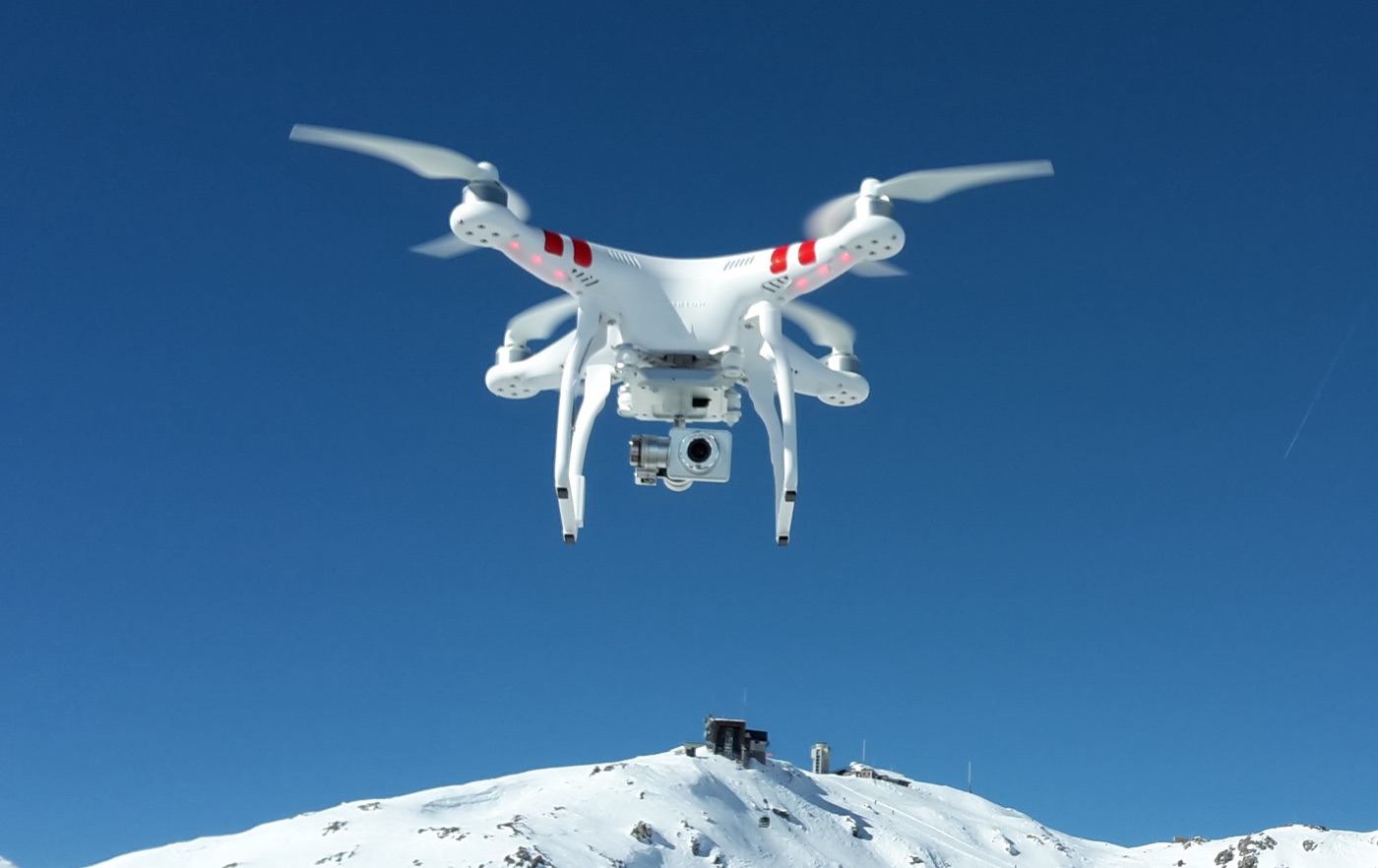
Image: Wikimedia Commons / CC BY-SA 3.0.
“Consumer-grade descent” is a phrase that gets stretched to fit anything. To keep this discussion bounded, the piece uses three hard criteria — all three must be met:
- ① Price · 2–3 orders of magnitude · ~50× or deeper. Drones ¥100,000+ → ¥3,000. CNC ¥500,000+ → ¥8,000. Spot $75,000 → $1,600. Exoskeleton $80,000 → $799.
- ② Use · Out of the box · zero calibration / tuning / maintenance. No professional training; no thick manual; no engineer hired to tune the machine. A consumer can start working in 10 minutes.
- ③ Footprint · Fits in home / garage · desk- or room-scale volume. No factory floor and no industrial power. Either fits on a desktop, or fits inside a home garage / small workshop.
Miss any of the three and it isn’t “consumer-grade descent”
Tesla can build the Model 3 at $35,000, but that isn’t “the consumer-grade descent of cars” — $35K isn’t a 50× compression of an existing car; Tesla is a “redefinition of the consumer product”, not a descent. By the same logic a 2D scanner at $500 (Epson) doesn’t qualify either — the original scanner was already $2,000-class, well short of two orders of magnitude.
Together the three criteria pin the discussion to “the hardcore categories that originally lived in defence / labs / factories, compressed to ordinary-consumer price points”.
Common path · Battlefield → factory → desktop: roughly 20 years per leap.
Drones (1917 → 2005): WWI aerial torpedoes → Cold War recon → post-9/11 weaponised platforms → consumer-grade after 2005. 3D printing (1980s → 2009): aerospace / auto prototyping → FDM patents lapse in 2009 → consumer entry. CNC (since 1952): US Air Force machined helicopter rotor blades → factory workhorse → desktop three- / five-axis (today). Lasers (1970s military → 2000s consumer), exoskeletons (2010s mil-medical → 2020s consumer), collaborative robotics (1980s industrial → 2020s desktop / education). The pattern is steady: roughly one leap every 20 years.
§02 · DJI — the bellwether
DJI is where this story begins. Founded by Frank Wang at HKUST in 2006; the Phantom line of 2013 turned consumer drones from “DIY assembly kits” into “out of the box”; the 2016 Mavic Pro folded into a backpack at $999. By 2024-2025:
| Metric | Value | Notes |
|---|---|---|
| Global consumer-drone share | 75–80% | Ceiling ~85% |
| Company valuation | $160–200B | Private · unlisted |
| 2024 market size | ~$11B | DJI 60%+ revenue share |
| 2024 industry growth | ~35% | 2025 US FCC restrictions = backhanded validation |
Five pillars of the DJI playbook
- Vertical integration. Gimbal motors, IMUs, GPS modules, video-link protocols — core components are designed and produced in-house. This avoids supply-chain lock-in and keeps iteration cycles controllable.
- Shenzhen supply chain. Within a 50 km radius you can source every component used by phones, cameras, appliances, autos, toys and medical electronics. Two-week prototyping, four-week pilot, twelve-week mass production — vs. 6–12 months in places like Boston.
- 12–18 month product cycle. Phantom 1 to Mavic Pro in just 3 years; Mavic Pro to Mavic 3 Pro in 6 — a major release every 12–18 months on average. A cadence chasers can rarely match.
- “Blue-sky strategy”. Lead with consumer imaging → extend into industrial use (agriculture, mapping, public safety) → cover the global market. This is the reverse path of Boston-area robotics firms — they start in industry / defence and struggle to reach consumer-grade price and experience.
Brand = category
Anywhere in the world today, the word “drone” and DJI are essentially the same. This is the strongest endpoint of consumer-grade descent: once “brand = category” is locked in, latecomers face a near-impossible chase — distribution, mindshare, word-of-mouth, supply chain and software ecosystem stack into a moat.
§03 · Bambu Lab — the successor
In November 2020 five former DJI employees — Tao Ye (CEO), Gao Xiufeng, Liu Huaiyu, Chen Zihan, and Wu Wei — founded Bambu Lab in Shenzhen. The X1 Carbon launched on Kickstarter in July 2022, raising $3M on day one and $7M in total. Three years later Bambu’s annual revenue was ¥6B ($800M–$1.2B), with ~29% of global consumer 3D-printer share and 37% in the sub-$2,500 band.
What Bambu changed technically (vs. 2022 Creality)
| Dimension | Mainstream (2022 Creality) | Bambu X1C |
|---|---|---|
| Architecture | Prusa-style (gantry + belt) | CoreXY · 500 mm/s print speed |
| Print speed | ~100 mm/s | 500 mm/s · 5× |
| Automation | Manual levelling, offset, compensation | Auto bed levelling · nozzle offset · vibration compensation |
| Multi-colour | Not supported | AMS auto material change · up to 16 colours |
| Quality verification | None | LIDAR first-layer quality check |
| Price | $400–$800 | From $1,199 |
Zero to $10B revenue in three years
Bambu’s trajectory is even faster than DJI’s: 2020 founded · 2022 first product · 2024 revenue ¥6B · ~1.2M units shipped in 2024. Same DJI formula — vertical integration + out-of-the-box + fast iteration + Shenzhen supply chain — plus one new ingredient: direct overseas reach via Kickstarter + Amazon + YouTube content marketing.
Bambu also lit a new analogy: “the next DJI” can be replicated. Provided you have 1) a team coming out of the previous-generation hardware winner, 2) the Shenzhen supply chain, 3) overseas direct-to-consumer chops, and 4) “an existing-but-not-yet-consumerised” hardcore category — you can ship a $10B-scale company in three years.
§04 · xTool — laser to desktop
xTool’s background: spun out of Makeblock in 2019, focused on consumer laser engravers / cutters. Preparing for a 2025 Hong Kong listing, backed by Tencent + Sequoia, with leadership including former AnkerMake executives. Its share of global laser-engrave/cut GMV is 47% (six times the runner-up).
The laser descent curve
| Category | Power | Footprint | Price |
|---|---|---|---|
| Factory CO₂ laser | 100–500W | Workshop-scale | $10K–$100K+ |
| Professional CO₂ | 60–80W | Small workshop | $5K–$15K |
| xTool P2 (consumer) | 55W CO₂ | Desktop enclosed · 5kg | $4,399 |
| xTool entry-level diode | 5–20W diode | Desktop | $500–$1,000 |
Overseas-first · content-marketing-driven
xTool’s playbook is very DJI / Anker: overseas Maker community first — YouTube gift-craft tutorials, side-business content, Etsy small-shop integration. Domestic China comes a step later. The global laser-tools market goes from $6.8B in 2024 to $39.1B by 2030 at a 33.8% CAGR — that is the wave xTool is riding.
§05 · Hypershell — the consumer exoskeleton
Hypershell was founded in Shenzhen in 2022 by Sun Kuan (90s-born, with a robotics-hardware + exoskeleton academic background). Product line: Go X 2kg / 15km battery / $799 · Ultra 2025 IFA Best Innovation winner · the first SGS-certified consumer exoskeleton.
From mil-medical to mountain hiking
| Dimension | Military / medical exoskeleton | Hypershell |
|---|---|---|
| Weight | 20–40kg | 2kg |
| Battery | External power / 1–2 hours | 15km · multi-hour |
| Price | $30,000–$80,000 | $799–$1,799 |
| Use case | Military / rehab clinics | Hiking / daily assist / elderly |
Validation signals · 2025
2025 Pre-B + B rounds totalled $70M at a ~$400M valuation. Investors: GH Ventures lead, Wofu Capital, Meituan Long-Pearl, Monolith. 70+ countries covered, tens of thousands of units shipped cumulatively; Kickstarter saw 2,600 backers raising $1.2M+ for 3,000 units.
This category has a special twist on the DJI / Bambu playbook: exoskeletons aren’t already “in the consumer’s mental shelf” the way drones or 3D printers were — it is a category that has to be created. Hypershell has to ship product and educate the category at the same time. So far it appears to be working.
§06 · Unitree — quadruped + humanoid
Unitree was founded in Hangzhou in 2016 by Wang Xingxing. Both the quadruped and humanoid lines are pursuing order-of-magnitude compression.
Quadruped comparison
| Product | Price | Positioning |
|---|---|---|
| Boston Dynamics Spot | ~$75,000 | Industrial · 2020+ |
| ANYmal (ETH lineage) | ~$150,000 | Mostly oil & gas |
| Unitree Go2 Air | $1,600 | Consumer / education |
| Unitree Go2 Pro | $2,800 | LiDAR + reinforced battery |
| Unitree Go2 EDU+ | $13,250 | Research / development |
Humanoids enter the ring
Unitree G1: $13,500 — the world’s first sub-$15,000 humanoid with “real motion capability”. For comparison: Figure 02 / Agility Digit are in the $50,000–$100,000 range. IEEE Spectrum’s 2023 review noted Go2 was “surprisingly close to Spot on multiple metrics”.
Humanoids are an older category than quadrupeds, but consumerised even less. With G1, Unitree pulled “humanoids” from “$50K lab equipment” to “$13.5K hobbyist-buyable” — the second descent after the quadruped.
§07 · Xmachine — five-axis to desktop
Xmachine XM-100: in-house five-axis motion control (RTCP true five-axis), 18,000 RPM permanent-magnet synchronous motor, high-precision sensors + wireless workpiece localisation. Desktop footprint (about the size of a monitor stand), priced at ¥58,000 (~$8,000).
The CNC descent ladder
| Category | Price | Footprint |
|---|---|---|
| Factory 5-axis (Fanuc / DMG MORI) | $150K–$3M+ | Workshop-scale · multi-tonne |
| Pro 5-axis (Haas UMC) | $100K–$200K | Small workshop |
| Desktop 3-axis (Carbide / Bantam) | $3K–$10K | Desktop |
| Xmachine XM-100 desktop 5-axis | $8,000 | Desktop · in-home |
Why “five-axis” matters
A five-axis CNC machines complex curved surfaces, turbine blades and aerospace structures — previously found only in industrial settings, and on the US export-control list. Bringing this category to a desktop means Makers and small studios can enter machining work that previously had to be sent out. The 2026 crowdfunding round was 102× oversubscribed — a demand signal, not final sales, but the community clearly recognises what this means.
There are limits, of course: small work envelope (~200mm), low spindle power (~500W), less rigidity than factory machines. For jewellers, dental technicians, furniture woodworkers and small-product designers it is more than enough.
§08 · Others — parallel downsizings
Beyond the six above, there is a wave of categories on the same path. Below are the cases observable in 2024-2025.
- Cobots · Kuka/ABB → DOBOT/Unitree. Industrial six-axis $300K–$800K → desktop six-axis $10K–$30K. The key driver: domestic substitution of harmonic reducers (Suzhou Leaderdrive, Laifu) drove cost down.
- AR / AI glasses · military → Rokid / Xreal. Military HMD / industrial CAD headsets $10K–$100K+ → Rokid Glasses 2025 production version at ¥2,499, on Qualcomm Snapdragon AR1. 500K+ pre-orders. Xreal, Pimax, TCL RayNeo are right behind.
- Thermal imaging · tank night-vision → iRay / HIKMICRO. Missile guidance / power-line inspection at tens of thousands of dollars per unit → phone modules / outdoor gear at $200–$3,000. 2024 global $7B, with Chinese vendors gaining share fast.
- Desktop instrumentation · Tektronix → UNI-T / Rigol. Oscilloscopes / multimeters / function generators — once $1,000–$10,000+ industrial-grade — now ¥1,500–¥5,000 with 100–200 MHz bandwidth, already approaching mid-range industrial.
- Smart soldering · Hakko → Miniware. Hakko / Weller industrial stations $300–$800 → Miniware TS80 / TS100 USB-C smart irons $70–$100, OLED + temperature curve + OTA. The hobby community has switched almost completely.
- Emerging categories. Desktop vacuum / pressure systems, desktop SEM electron microscopes, desktop CT scanners — show up sporadically, 1–2 orders of magnitude below industrial pricing. No category-defining player yet, but this is the battlefield of the next five years.
§09 · Market strata — the strata model
Every hardcore category divides into three layers. Consumer is the smallest layer, but grows fastest — it’s where “brand = category” winner-take-most dynamics actually play out.
3D printing as the worked example
| Layer | Market size | Price band | Representative players |
|---|---|---|---|
| Consumer | ~$6B/yr | $200–$1,500 | Bambu Lab · Creality |
| Pro | ~$8B/yr | $3K–$15K | Raise3D · Formlabs |
| Industrial | $21B+/yr | $100K–$2M+ | BLT (Bright Laser) · EOS · Stratasys |
Four structural observations
- Consumer is smallest (typically 5–15%) but grows fastest — the winner-take-most pool.
- Industrial is the biggest and steadiest — material qualifications, customer relationships and precision thresholds form the deepest moat; consumer brands rarely break in.
- The pro layer is the most fragile — squeezed simultaneously by the rising quality of consumer-grade and the falling price of industrial. Formlabs and Raise3D have shallower moats than industrial players.
- Descent only flows one way — consumer brands moving up to pro is fine; industrial brands moving down to consumer is essentially impossible (cadence mismatch).
Layer sizes across other categories
| Category | Consumer | Pro | Industrial |
|---|---|---|---|
| Drones | $11B | $25B | $50B+ |
| CNC | $3B | $40B | $80B+ |
| Quadruped robots | Emerging | ~$1B | $2B |
| Laser engrave / cut | $3B | $8B | $20B+ |
§10 · Why Shenzhen — why this geography
Five of the six are in Shenzhen, one in Hangzhou (Unitree) — that is not an accident. As the epicentre of hardware iteration, Shenzhen + the Yangtze Delta has four conditions that few other places possess simultaneously.
- #1 · Supply chain density. Every component used by phones, cameras, appliances, autos, toys and medical electronics is within 50 km (Shenzhen) or 300 km (the Yangtze Delta). Drone-component supply chains overlap 95% with phone / camera supply chains. Shenzhen cadence: 2-week prototype · 4-week pilot · 12-week mass production. Boston-area: 6–12 months.
- #2 · Engineering cost structure. Shenzhen senior hardware engineers earn ¥300K–¥800K (~$50K–$120K). Silicon Valley pays $200K–$400K — a 4–8× gap. Hardware iteration needs simultaneous coverage of “circuits + mechanics + firmware + algorithms”; cost determines how many people you can field. Implication: DJI / Bambu can staff 1,000–3,000 hardware engineers; Boston startups cannot.
- #3 · Iteration velocity. Shenzhen-rooted startups iterate 3–6 months (minor) / 12 months (major). North America / Europe runs 18–24. Consumer-grade descent demands “industrial → consumer” compression in 2–3 iterations — non-Shenzhen speeds cannot achieve it. The gap isn’t “a bit faster”; it’s a 2×+ gap — a life-or-death difference.
- #4 · Export capability. Since 2018, Chinese hardware teams collectively mastered the Amazon + DTC site + Kickstarter + YouTube KOL overseas formula. xTool, Hypershell, Bambu all run “overseas first, domestic later”. Anker was a lone case ten years ago; today there are dozens doing it in parallel. Implication: brand reaches high-margin overseas users directly.
Conclusion · Shenzhen + the Yangtze Delta have a 3–5× efficiency advantage in hardware-iteration startups.
This isn’t a result of policy subsidies — it is the result of industrial-ecosystem self-evolution: 1990s OEM → 2000s shanzhai phones → 2010s Maker movement → 2020s consumer-hardware renaissance. Four necessary conditions stack on top of each other; other geographies have at most one or two. The gap determines who can build a $10B consumer-hardware company in three years.
§11 · Common pattern — the pattern
Lay DJI, Bambu, xTool, Hypershell, Unitree and Xmachine side by side and five common patterns emerge. This is the operating manual of “consumer-grade descent”.
- Teams come from the previous-generation winner. Bambu’s five founders are all ex-DJI; xTool leadership includes former AnkerMake executives; Hypershell’s founder has a robotics + exoskeleton academic background. Without “previous-generation hardware experience”, 90% of attempts fail at the start.
- Overseas first, domestic later. Kickstarter → Amazon → DTC site → brand. Overseas users have higher willingness-to-pay for new categories and stronger content reach; the domestic hobby ceiling is low. Going overseas first is rational, not contrarian.
- Vertical integration + Shenzhen supply chain hybrid. In-house core components (control boards, motors, algorithms); peripheral modules sourced as Shenzhen standard parts. Lets a small team ship a product in a 12-month window. Pure in-house is too slow; pure off-the-shelf has no differentiation — hybrid is optimal.
- Software is half the hardware. DJI Fly, Bambu Studio, Unitree App — consumer experience is 50% hardware + 50% software. For non-engineer users, “ease of use” determines the ceiling. Boston Dynamics’ Spot is expensive not just because of hardware, but because it never built consumer-grade software.
- Brand = category. DJI = drones · Bambu = 3D printers · xTool = laser engravers · Hypershell = exoskeletons · Unitree = robot dogs. This is the final lock on consumer-grade descent — once brand = category, latecomers need 5–10 years and billions to flip it.
- $1B+ revenue / 30% share within 3 years. Zero to $1B+ annual revenue · 30%+ global share · brand = category. DJI did it in five years; Bambu in three. It is now a repeatable playbook.
Future shortlist · categories not yet consumerised
- SEM · Desktop electron microscope. Industrial $50K–$500K · lab-only · zero consumerisation. A real “desktop SEM” = the DJI moment for semiconductor / materials hobbyists.
- Mass Spec · Desktop mass spectrometer. $100K–$1M · lab-grade · food analysis, environmental testing, drug analysis. Compress to $5K–$10K and a new category opens up.
- Cryo-EM · Desktop cryo-electron microscope. $1M+ · the biology miracle tool. The leap may be too far, but worth a bet on a 10-year horizon.
- Assembly Robot · Desktop precision-assembly robot. Industrial $100K+ · the consumer version is likely to be taken by a Unitree / Dobot derivative line.
- Prosthetic · Consumer-grade smart prosthetics. Össur / Ottobock $10K–$100K · 3D printing + EMG sensing have a shot at $1K–$3K.
- BCI · Consumer brain-computer interface. Invasive Neuralink is far away; non-invasive EEG headbands are dropping from $5K+ toward $500–$1,000.
A ten-year forecast · Every category of industrial / lab equipment will have a Shenzhen or Hangzhou version within ten years.
The “2kg / $799 / out-of-the-box” positioning will spread to every hardcore category. This isn’t a “made-in-China” story; it is — a new species evolved in a particular geography + industrial ecosystem. Linus Torvalds wrote in Just for Fun that human motivation rises through survival → social → entertainment. Consumer-grade descent of hardcore industry is the same curve, projected onto the tools layer — machines once meant for professionals are turning into hobbyist toys; toys = entertainment = growth engine.