The AI capex super-cycle: who’s selling the shovels.
2025 is the “year zero” of the datacenter super-cycle: global datacenter capex is up +57% YoY (Dell’Oro), the four big US clouds (AMZN / GOOGL / META / MSFT) are running combined capex +76%, and Q3 single-quarter hyperscaler capex hit a record $142B. Gartner pegs global datacenter systems spend at $489.5B (+47% YoY), with another +19% in 2026. This is not the 2017 cloud-migration wave — it’s AI training demand pushing silicon, HBM, CoWoS, optical modules, coolant, transformers, land and electricity all into bottleneck. This page lays the AI infra chain on the table: from one NVDA H100 / B200 ship-out, to TSMC’s CoWoS line, to one 800G optical module from Innolight, to one Vertiv liquid-cooling CDU, to one Equinix colo hall, to the 20-year nuclear PPA Microsoft signed with Constellation — at every layer, who can do the work, who collects the revenue, where the bottleneck is.
§01 · Global overview — $1T capex · 122 GW installed · 17 years of acceleration
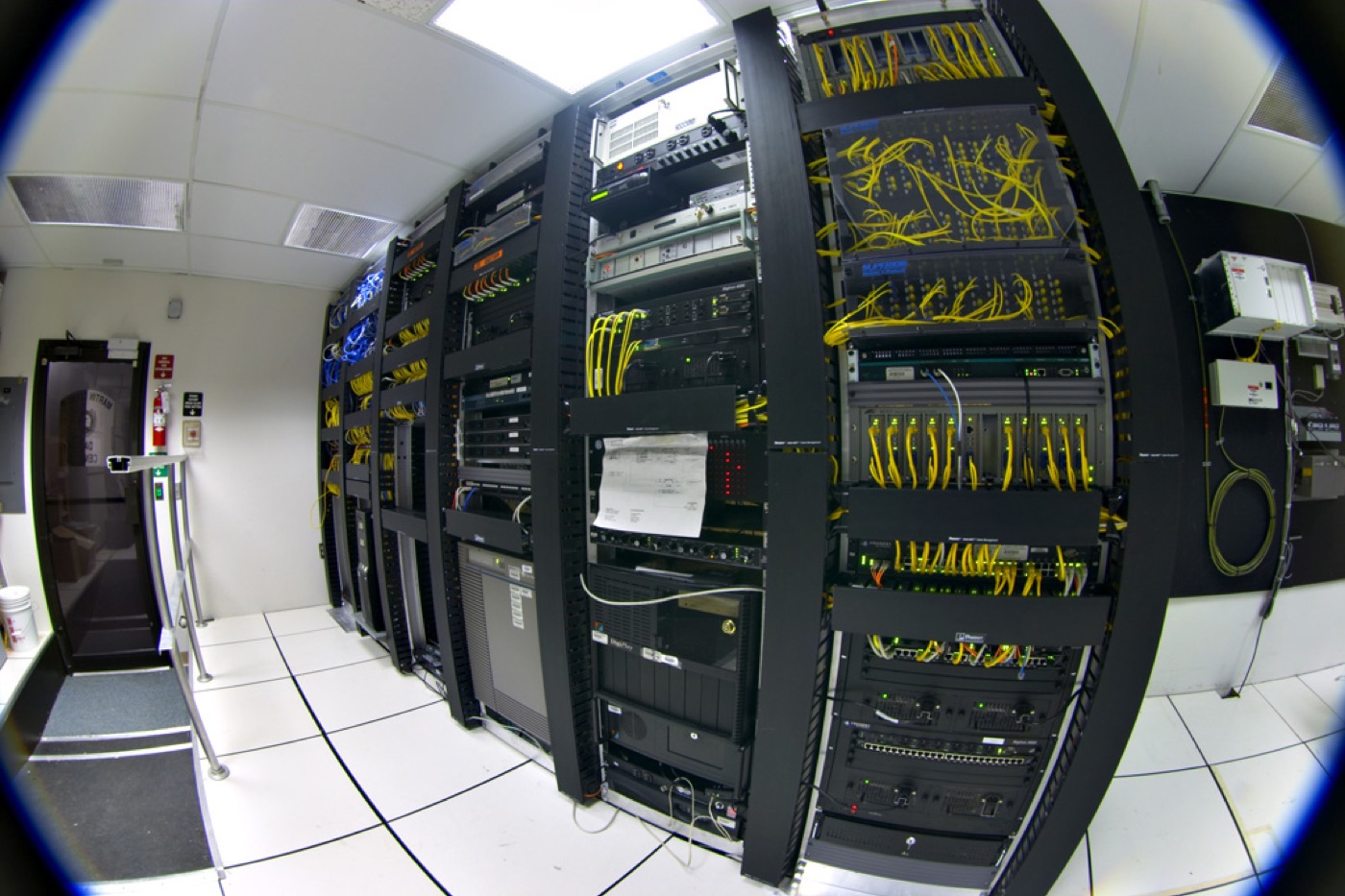
Image: Wikimedia Commons / CC BY-SA 3.0.
Over the past 18 months, datacenters have moved from “a hyperscaler infra topic” to the largest capex theme in global capital markets. 2024 was the capex inflection, 2025 was structural ramp, and 2026’s combined hyperscaler outlook is forecast to break $690B (Futurum), with global datacenter capex crossing $1 trillion for the first time (Dell’Oro). The drivers stack: ① training-side GPU clusters scaling from tens-of-thousands toward hundreds-of-thousands of cards, ② inference-side AI application ARR jumping from $20B to $50B+ in twelve months, ③ power and land “physical bottlenecks” starting to repricing, pushing the entire chain upstream.
Structurally this is a “hardware + heavy-asset”-led super-cycle: NVIDIA alone runs ~$112B FY2026 datacenter revenue, Broadcom AI ASIC ~$20B, Foxconn jumping to NT$8.1T total revenue, Vertiv backlog from $4.5B (2023) to $9.5B (Q3 2025), Equinix/DLR powered land reserves now measured in GWs. The “shovel-seller” trade is being repriced as “shovels + mines + power”.
| Metric | Value | Delta | Note |
|---|---|---|---|
| DC systems spend 2025 | $489B | +46.8% YoY | Gartner · 2026 forecast $582B |
| DC capex 2026E | $1.0T | 21% CAGR to 2029 | Dell’Oro Group |
| Global IT installed power | 122 GW | +97 GW by 2030 | JLL Q1 2025 |
| Q3’25 hyperscaler capex | $142B | +180% / 3Y | Synergy Research |
Big four US clouds + Oracle · 2024 → 2026E capex
| Company | FY2024 capex ($B) | FY2025 capex ($B) | FY2026 guide ($B) | Primary use |
|---|---|---|---|---|
| Microsoft | 44.5 | 64.6 | ~120+ | Azure AI · OpenAI training · Q1 FY26 single-quarter $11.1B datacenter leases |
| Alphabet (Google) | 52.5 | 91.4 | 175-185 | TPU clusters · Google Cloud · Gemini · YouTube |
| Meta | ~40 | 72.2 | 115-135 | GPU clusters · MTIA v2 · multiple GW-scale campuses |
| Amazon (AWS heavy) | ~77 | ~125 | ~200 | AWS · Trainium2 · nuclear campuses |
| Oracle | 6-7 | 21.2 | ~35+ | OCI accelerators · single 5.4 GW lease, the largest ever |
| US 5 combined | ~220 | ~374 | ~645+ | ~3× over two years |
Sources: company 10-K / 10-Q / earnings releases (Microsoft FY ends June · Alphabet/Meta/Amazon calendar year · Oracle FY ends May). Microsoft has not given an absolute FY26 number, but Q1 FY26 single-quarter capex run-rate already exceeded $30B. Oracle CFO Catz has repeatedly suggested $35B may understate. Combined Big Tech AI spend 2025 ≈ $630B (Fortune) → 2026 ≈ $690B (Futurum).
The Chinese four · BABA / Tencent / ByteDance / Baidu
Chinese cloud capex runs about a year behind the US but is accelerating at a similar pace: Alibaba in November disclosed ~$16B TTM AI-related spend with a 3-year plan of $52.4B (later reportedly revised up to $69B); ByteDance’s 2025 plan is ¥160B ($22B), of which ¥90B for compute; the four together commit $84B+ for 2025-2027, with 2025 growth of +60% YoY. Goldman estimates Chinese AI players will spend ~$70B on datacenters cumulatively over three years.
Bottom Line · This is a capex cycle “pushed by two major demand sides simultaneously” — something not seen in 30 years.
Internet build-out (2000) and smartphone infra (2010) were each driven by a single demand side. This wave is ① AI training (model size / context window / multi-modal still expanding) + ② AI inference (application ARR up 5-10× in 12 months) in lockstep — training feeds H100/B200 clusters, inference feeds ASIC + edge GPUs; the former eats HBM, the latter eats optical networks, and both eat electricity. “This wave’s bottleneck isn’t GPUs, it’s power” is the 2025-2026 industry consensus. That has pushed the investment lens toward nuclear / transformers / liquid cooling / HVDC — the most upstream rings of the chain are being repriced.
§02 · Upstream · Silicon — GPU · ASIC · CPU · HBM · CoWoS
The apex of the pyramid is silicon. AI chips total ~$200B+ in 2025, with NVIDIA alone taking more than half (datacenter revenue ~$112B FY26). AMD scales EPYC + Instinct to $16.6B; Broadcom takes ~$20B from custom ASICs for six customers including Google and Meta. Below sit HBM (SK Hynix / Samsung / Micron) and CoWoS packaging (TSMC + Amkor + SPIL), each layer hitting supply bottlenecks in 2024-2025. For company-level detail see NVDA earnings.
GPU / ASIC / CPU · 2025 actual revenue
| Company | Ticker | Market cap ($B) | 2025 datacenter revenue ($B) | YoY % | Flagship products |
|---|---|---|---|---|---|
| NVIDIA | NVDA | ~3,400 | 112 (FY26) | +90% (FY26) | H100 / H200 / B200 / GB200 NVL72 |
| AMD | AMD | ~280 | 16.6 | +32% | EPYC 9005 · MI300X / MI325X / MI355X |
| Broadcom | AVGO | ~1,100 | ~20 (AI) | +65% | Google TPU · Meta MTIA · network ASICs · backlog $73B |
| Marvell | MRVL | ~70 | ~1.5 (AI) | +170% | DSP · custom ASICs · 800G/1.6T optical interfaces |
| Intel DCAI | INTC | ~95 | 16.9 | +5% | Xeon 6 · Gaudi 3 (weak in AI edge) |
Sources: NVDA FY26 release (FY ends Jan); AMD / Intel / Broadcom / Marvell FY25 releases. Broadcom AI revenue is custom XPUs + network ASICs combined for six major customers (Google / Meta / ByteDance / OpenAI / etc.); end-FY25 backlog $73B, 2027 target $100B+ AI revenue. Market caps as of ~2026-04-21.
HBM memory · “the real AI bottleneck”
Each H100 carries 80GB of HBM3, B200 carries 192GB of HBM3e, and GB200 NVL72 packs 13.4TB of HBM in a single rack. HBM is both a performance and capacity bottleneck — capacity is set by three oligopolists. Global HBM TAM is roughly $35B in 2025, projected to hit $100B by 2028 (~3× in three years).
- SK Hynix · #1 HBM maker globally, ~57% share Q3’25, sole or primary supplier for NVIDIA H/B series
- Samsung · 22% share (Q3’25); HBM4 share could rebound to 30%+ if it passes NVIDIA qualification in 2026
- Micron · 21% share, ahead of Samsung on HBM3e, second source for NVIDIA H200 / B200
SK Hynix briefly overtook Samsung’s market cap in 2025 (Counterpoint), becoming the world’s largest memory maker — first time in three decades.
CoWoS packaging · TSMC tripling in three years
CoWoS (Chip-on-Wafer-on-Substrate) is TSMC’s 2.5D advanced packaging for NVIDIA / AMD high-end GPUs, mounting GPU + HBM on a single interposer. CoWoS capacity is the real ceiling for AI GPU shipments.
- 2024 ~35-40K wafers/month
- 2025 75K wafers/month, doubled
- 2026 year-end target 120-130K wafers/month
- 2026 also outsourcing 240-270K wafers/year to Amkor + SPIL
- NVIDIA locks ~50%+ of TSMC CoWoS capacity for 2026-27
TSMC is expanding in Arizona / Kumamoto, but training advanced-packaging engineers is a slow variable — that’s why 2026-2027 supply forecasts still hinge on the actual CoWoS ramp.
Sources: Counterpoint Research / Astute Group / TrendForce HBM quarterly reports; SK Hynix / Samsung / Micron filings; TSMC earnings calls (Wei comments); NVIDIA / AMD GPU roadmaps. HBM share is by revenue; capacity-share figures differ slightly. CoWoS capacity figures are from TSMC earnings calls + DigiTimes channel checks.
§03 · Upstream · Networking / Optics — back-end fabric is the new bottleneck
Training a 10K-GPU cluster requires multi-TB/s of bandwidth between GPUs — AI training’s brute-force network demand. NVIDIA links GPUs internally with InfiniBand (acquired from Mellanox) or NVLink; back-end fabric (the GPU-to-GPU network) is the fastest-growing sub-segment of the past three years. Arista pulled in over $1.5B of back-end AI networking revenue in 2025; Broadcom Tomahawk 6 switch ASIC pushes single-chip bandwidth to 102.4 Tbps.
Switches / routers · 2025 actuals
| Company | Ticker | Market cap ($B) | 2025 revenue ($B) | YoY % | AI angle |
|---|---|---|---|---|---|
| Arista Networks | ANET | ~150 | 9.0 | +28.6% | AI back-end network > $1.5B · 65% revenue from cloud/AI |
| Cisco | CSCO | ~250 | 54+ (FY26 run rate) | +8% | AI hyperscaler orders ~$3B FY26 guide |
| Juniper / HPE Networking | HPE | ~30 | 17.8 (server segment) | +10% | HPE closed Juniper $14B acquisition 2024-07 |
Optical modules · 2025 explosion
The 800G module market expanded from $8.6B to $12B (+40%) from 2024 to 2025; 1.6T modules entered volume production in H2 2025, with under 1M units shipped but a steep curve; total datacenter optical components broke $16B (+60% YoY) in 2025 (Cignal AI).
| Vendor | Country / Ticker | Flagship products | 2025 highlight |
|---|---|---|---|
| Innolight | China · 300308.SZ | 800G/1.6T optical modules | Together with Eoptolink, ~60% of NVIDIA 800G orders |
| Eoptolink | China · 300502.SZ | 800G/1.6T optical modules | Same 60% (NVIDIA dual-source) |
| Coherent | US · COHR | EML lasers + DSP modules | 100/400/800G optics; remaining ~40% split with Lumentum |
| Lumentum | US · LITE | EML / VCSEL / modules | Datacenter rebound · turned profitable in 2025 |
| Accelink | China · 002281.SZ | 200G/400G optical modules | Mid-tier optics; one of top 5 |
| Broadcom | US · AVGO | Switch ASIC + optical modules | Tomahawk 6 = 102.4 Tbps, the only one in the industry |
Switch ASIC · DSP duopoly
- Broadcom · ~80% switch-ASIC share. Tomahawk (datacenter high-bandwidth), Jericho (telecom-grade), StrataXGS (enterprise). Tomahawk 6 launched 2025-06 at 102.4 Tbps, “exclusive” in industry. The remaining share is split between Marvell ~10% and in-house silicon (Cisco / Arista).
- Marvell · ≥80% optical-DSP share. Near-monopoly in 200G/400G/800G PAM4 DSPs. FY25 datacenter is 75% of company revenue; AI revenue +170%. Seen as the “hidden champion of optical modules” — the more optical vendors earn, the more Marvell earns.
Sources: Cignal AI datacenter optical components quarterly; Arista / Cisco / HPE / Marvell / Broadcom filings; LightCounting 800G shipment tracking; NVIDIA channel optical-module surveys. The “60%” figure for Innolight + Eoptolink in NVIDIA 800G total orders is an industry-survey estimate; specific cuts vary.
§04 · Midstream · Servers & ODMs — $366B server market · AI is half
The 2025 global server market is $366B (+45% YoY) (IDC), with GPU-embedded servers estimated at ~50% of value. This layer is a two-tier “US brands (Dell / HPE / SMCI) + Taiwanese ODMs (Foxconn / Quanta / Wistron / Wiwynn)” structure — US firms own the customer relationships and brands, Taiwan ODMs do the actual building. AI server (NVIDIA HGX / GB200 NVL72) manufacturing is highly concentrated: Foxconn alone takes most GB200 orders.
US brands · server systems vendors
| Company | Ticker | Market cap ($B) | 2025 revenue ($B) | AI server revenue ($B) | Highlights |
|---|---|---|---|---|---|
| Super Micro | SMCI | ~25 | 22.0 (FY25, June) | ~70% AI | FY26 guide ≥$33B; primary NVIDIA system contract manufacturer |
| Dell ISG | DELL | ~85 | 95.6 (FY25) | 24.6 (FY26) | FY26 AI servers 2.5×; H1 single-period $10B shipped |
| HPE | HPE | ~30 | 34.3 (FY25, October) | ~6.8 new orders | Closed Juniper acquisition; server segment +10% |
Taiwan ODMs · the actual builders
Real GB200 / B300 server clusters are built by Taiwan ODMs in Mexico / Vietnam / Taiwan. Monthly revenue YoY for November 2025:
| Vendor | Nov 2025 revenue (NT$B) | YoY % | 2025 full-year highlight | AI thread |
|---|---|---|---|---|
| Foxconn | 844.3 | +25.5% | FY25 NT$8.1T (+18%); 2026 target >NT$9T | Primary ODM for NVIDIA HGX/GB200/B300 |
| Wistron | 280.6 | +194.6% | Largest AI server beta · FY25 3× | NVIDIA HGX systems; closing on Foxconn |
| Quanta | 192.9 | +36.5% | AI servers ~70% of 2025 revenue | Custom GPU platforms for Meta / AWS |
| Wiwynn | 96.9 | +158.6% | FY25 full-year +148.9% (industry-best) | Lead hyperscale ODM for Microsoft Azure |
| Inventec | 52.2 | −14.3% | Did not catch the GB200 transition | More L6/L10 OEM · weak GPU line |
Sources: monthly revenue announcements (Taiwan exchange); Foxconn earnings calls; TrendForce / DigiTimes channel checks. Wistron’s +194.6% comes mainly from NVIDIA HGX H200 / GB200 system shipments. Wiwynn is Microsoft’s #1 datacenter ODM. Inventec lags on GPU systems but remains a traditional Lenovo / Dell server OEM.
§05 · Midstream · Power & Cooling — Liquid cooling / UPS / distribution as the second-tier beta
Each H100 idles at 700W, B200 climbs to 1000W, and GB200 to 1200W; one fully-loaded GB200 NVL72 rack hits 120-140 kW — 3× the 30-40 kW of last-generation air-cooled racks. This pushes “power” and “cooling” from infrastructure into investment themes: Vertiv’s 2025 revenue guide is $13.75B with $9.5B backlog (book-to-bill 1.4×); Schneider Electric’s datacenter segment ~€12B at ~30% of company revenue; Eaton datacenter orders +70%. The three threads here are liquid cooling + medium-voltage distribution + high-efficiency UPS.
Electrical / cooling vendors · 2025 actuals
| Company | Ticker | Market cap ($B) | 2025 revenue ($B) | DC share | Highlights |
|---|---|---|---|---|---|
| Vertiv | VRT | ~50 | ~13.75 | ~80% | #1 in liquid cooling (11.3%) · backlog $9.5B · book-to-bill 1.4× |
| Schneider Electric | SU.PA | ~150 | ~44 (€40.2B) | ~30% | DC & Networks segment ≈ €12B, double-digit growth |
| Eaton | ETN | ~140 | 27.4 | ~25% (electrical segment) | DC orders Q3 +70% · Boyd Thermal acquisition adds liquid cooling |
| nVent Electric | NVT | ~15 | ~3.5 | ~30% | Liquid-cooling manifolds + busbar · 2025 +30% |
Liquid cooling · three mainstream approaches
- D2C · Direct-to-Chip cold plate. Cold plate sits on the GPU/CPU, fluid loop carries heat. Standard approach for GB200 NVL72. Suppliers: CoolIT, Asetek, Vertiv Liebert XDU, Schneider, etc. ~70% of new liquid-cooling deployments.
- Immersion. Whole servers submerged in dielectric fluid (single- or two-phase). PUE near 1.02, but high deployment cost and ops complexity. Submer / GRC / LiquidStack lead. Chinese SUGON / Lenovo / Inspur also have offerings. Small share but fast-growing.
- Rear Door HX · Rear-door heat exchanger. Heat exchanger added at rack rear — a transitional approach for “soft retrofitting” air-cooled datacenters. Vertiv / Schneider / Sugon all offer products. Suits 30-50 kW rack densities; above GB200, a D2C upgrade is required.
Liquid-cooling market size · 2025 ~$5-7B → 2033E $20-30B (20% CAGR).
Before 2024 liquid cooling was a niche pilot; in 2025 it became mandatory configuration for new AI datacenters as GB200 NVL72 rolled out. Vertiv leads with 11.3% share, but post-GB200 the market is being reshaped — CoolIT (Cooler Master investment), Asetek, Schneider’s Motivair acquisition, Eaton’s Boyd acquisition are all racing for position. Liquid-cooling capex could long-term move from 5% of total DC build cost to 15-25%.
Sources: Grand View Research / GM Insights liquid-cooling reports; Vertiv / Schneider / Eaton FY25 earnings calls; NVIDIA GB200 reference architecture. GB200 NVL72 is 130 kW per rack and a fully-loaded room needs 30+ kW/m² of heat rejection — close to nuclear-cooling-tower density.
§06 · Midstream · Datacenter / Colo — REIT · powered land · 1% vacancy
A real “datacenter” is concrete + power interconnect + cooling — physical building, not cloud software. Two camps here: ① REIT model (Equinix / Digital Realty) — long-term hold + lease; ② private / hyperscaler self-build — QTS (acquired by Blackstone), CyrusOne (KKR + Global Infrastructure Partners), Vantage, Stack Infrastructure, etc. In 2025, US primary markets posted record-low vacancy of 1.6% (CBRE) / 1.0% (JLL) — Northern Virginia / Dallas / Phoenix barely take retail orders.
Two listed REITs
| Company | Ticker | Market cap ($B) | 2025 revenue ($B) | Developed capacity | Highlights |
|---|---|---|---|---|---|
| Equinix | EQIX | ~80 | 9.22 | ~3 GW | Targets capacity doubling by 2029 · 260+ DCs globally |
| Digital Realty | DLR | ~55 | 6.11 | 5 GW powered land | 769 MW under construction · long-term hyperscaler leases |
US primary markets · capacity & rent
| Market | Operating (MW) | Under construction (MW) | Planned (MW) | 2025 price change |
|---|---|---|---|---|
| Northern Virginia | ~4,900 | 2,078 | 5,900 | 10MW+ rents +13.8% YTD · world’s highest |
| Dallas-Fort Worth | ~1,500 | ~1,000 | 3,900 | Triggered by Oracle’s record 5.4 GW order |
| Phoenix | ~1,380 | 1,300 | 4,200 | Climate + relatively abundant power, new hotspot |
| Atlanta | ~600 | ~800 | ~2,500 | Microsoft / Meta building here |
| Chicago | ~700 | ~400 | ~1,500 | Midwest financial datacenter hub |
| US 5 markets combined | ~9,080 | ~5,580 | ~18,000 | Record-low vacancy 1-1.6% |
Sources: CBRE North America Data Center Trends H1 2025; JLL North America Data Center Report YE 2025; Equinix / DLR Q4 2025 earnings. Q3 2025 US hyperscaler single-quarter leasing 7.4 GW > full-year 2024 of 7 GW. Oracle’s single 5.4 GW deal is the largest hyperscale lease ever.
⚠ The “deceptively stable” datacenter REIT · 15-year leases + 8% escalators ≠ permanent earnings.
EQIX / DLR look like rent-collecting REITs but carry three layers of cyclical risk: ① accelerated depreciation (each GB200 generation shortens 5-year customer hardware cycles, lagging-PUE infra falls out of favor); ② rate-sensitivity (high-leverage REITs took -30% drawdowns in 2022-23); ③ AI self-build (Microsoft / Meta / Amazon increasingly self-build, cutting colo-leasing share). In this AI cycle, REIT beta is smaller than manufacturing’s and less volatile, but alpha ceiling is also lower.
§07 · Downstream · Cloud and AI — End demand · ARR 5× in 12 months
The ultimate buyers of all this capex are clouds and AI labs. The table below puts 2025 actual cloud revenue alongside major AI-lab ARR — the dual-ARR curve of training and inference is the fundamental reason for this infra super-cycle.
Three public clouds · 2025 actual revenue
| Cloud | Parent | 2025 revenue (run-rate, $B) | YoY % | Highlights |
|---|---|---|---|---|
| AWS | AMZN | ~117 (Q1 ARR) | +20% | Anthropic primary cloud · Trainium2 · 50+ GW pipeline |
| Azure | MSFT | 75+ (FY25) | +34% | OpenAI primary cloud · first standalone disclosure |
| Google Cloud | GOOGL | ~50+ (annualized) | +32% | Custom TPU · Gemini · fastest-growing of the three |
| Oracle Cloud | ORCL | ~24 (OCI run-rate) | +50% | Single 5.4 GW long lease with OpenAI |
AI labs · ARR progression
| Company | End-2024 ARR | End-2025 ARR | 2026 Q1 ARR | Primary cloud |
|---|---|---|---|---|
| OpenAI | ~$3.7B | ~$20B | ~$24-25B | Microsoft Azure (+ Oracle / SoftBank) |
| Anthropic | ~$1B | ~$9B | ~$22-30B | AWS + Google Cloud (dual primary) |
| xAI | n/a | ~$2B (est.) | ~$5B (est.) | Self-built Colossus (Memphis 200K H100/H200) |
| Mistral / Cohere / Inflection etc. | — | ~$1-3B combined | — | Multi-cloud across AWS / GCP / Azure |
Sources: The Information / Bloomberg ARR tracking; OpenAI / Anthropic earnings calls; The Information 2026-04 update. Anthropic’s 2026 ARR has both “incl. partner gross” and “OpenAI-comparable” cuts — $22B is the comparable figure, $30B the gross. Claude Code alone hit $2.5B ARR by 2026-02.
Why this capex cycle won’t stop · When customer ARR is 5× in 12 months, cloud capex lags but is forced to chase.
OpenAI ARR went from $3.7B (end-2024) → $20B (end-2025) → $25B (2026 Q1); Anthropic in lockstep from $1B to $20B+. AI-lab API call volumes doubled, but GPU inference capacity is actually short — Microsoft has repeatedly noted “delivery timing is constraining Azure AI revenue growth”. That is exactly why hyperscaler capex doubling in a year can still be “capacity-constrained”. When a customer demand curve has a steeper slope than supply, the capex cycle doesn’t end naturally — it ends only by ① model capability convergence, ② end-customer ARR slowdown, or ③ physical bottleneck on power / land.
§08 · Power and nuclear — Datacenter electricity is becoming a new sector
The December 2024 US DOE/LBNL report puts US datacenter electricity demand for 2028 at the high end at 325-580 TWh (6.7-12% of total US generation) — vs. baseline 2023 of just 176 TWh (4.4%). EPRI estimates datacenters could be 9% of US generation by 2030. Power has become the longest bottleneck in the AI capex cycle — a 1 GW datacenter campus takes 3-7 years from PPA to commissioning. That is the fundamental reason hyperscalers have raced to grab nuclear, wind/solar/storage, and PPAs in 2024-2025.
US datacenter electricity demand · DOE / LBNL / EPRI
| Year | Demand (TWh) | % of US generation | Source |
|---|---|---|---|
| 2018 | ~76 | ~1.9% | LBNL historical |
| 2023 | 176 | 4.4% | DOE/LBNL Dec 2024 |
| 2025E | ~250 | ~6% | EPRI 2024 mid |
| 2028E (DOE high) | 325-580 | 6.7-12% | DOE/LBNL 2024 |
| 2030E (EPRI mid) | ~400 | 9% | EPRI Powering Intelligence |
| 2030E (BCG high) | ~970 | ~20% | BCG extreme scenario |
Hyperscaler power grab · 2024-2026 major PPAs
| Buyer | Seller | Capacity (MW) | Type | Term | Highlights |
|---|---|---|---|---|---|
| Microsoft | Constellation Energy | 835 | Nuclear (restart) | 20 years | Three Mile Island Unit 1 restart · ~$110-115/MWh |
| Amazon | Talen Energy | 1,920 | Nuclear (operating) | through 2042 | Susquehanna-adjacent $650M campus · AWS investing $20B+ |
| Kairos Power | 500 | SMR (new build) | through 2035 | World’s first commercial SMR PPA · first unit 2030 | |
| Meta | Vistra · Oklo · TerraPower | ~6,600 | Nuclear (mixed) | 20+ years | Multiple deals signed Jan 2026 · Vistra 2,600 MW lead |
| Microsoft | Brookfield Renewable | 10,500 | Wind/solar | through 2030 | Largest wind/solar PPA ever |
Sources: company announcements from Constellation / Talen / Kairos / Meta; Utility Dive / Bloomberg tracking. Microsoft + Constellation Three Mile Island restart targets 2028 commissioning; PPA price not disclosed, $110-115/MWh is an analyst estimate. Amazon expanded purchases after FERC reviewed 1,920 MW; FERC also approved direct grid interconnection.
“We’re not short on GPUs anymore — we’re short on power. Our biggest bottleneck for all of 2026 is the speed of grid interconnection.”
— Paraphrased, US top-tier hyperscaler infrastructure lead, 2025 Q4
For detailed nuclear chain analysis see Nuclear power chain · 2024-2026 data pack (companion page).
§09 · US-China rivalry — Sanctions · export controls · self-sufficiency race
From the October 2022 US export controls on Chinese chips, the US and China have entered structural decoupling on the datacenter / AI track. US side: H100 / B200 are not exported, HBM is constrained, EUV is locked. China side: Huawei Ascend 910C / Cambricon / SMIC’s N+2 node are gradually maturing; in 2025 Alibaba Cloud has partially substituted NVIDIA with Hanguang 800 + Ascend 910C. China’s datacenter AI-chip self-sufficiency has risen from <5% to 30%+ over three years (CITIC Securities estimate).
Major Chinese AI chip vendors · 2025 actual progress
| Vendor | Flagship products | Performance positioning | 2025 progress |
|---|---|---|---|
| Huawei HiSilicon | Ascend 910B / 910C | ~A100-class | Q4 2025 910C in volume · Alibaba / Tencent / ByteDance orders |
| Cambricon | Siyuan 590 / 690 | ~A800 close | 2025 revenue +200%+, share price doubled |
| Biren | BR104 / BR110 | ~A100-class | Capacity constrained under export control; rerouted off TSMC |
| Moore Threads | MTT S4000 | Mid-tier GPU | IPO Sep 2025; +200% on Day 1 |
| Alibaba T-Head | Hanguang 800 / Zhenyue | Inference-only | 2026 Alibaba Cloud target ~30% of inference compute internal |
| SMIC | 7nm (N+2) process | Foundry node | Huawei Mate 60 validated N+2 volume capability |
US vs China · share of global capex
By capex, US hyperscalers combined 2025 capex is $374B vs. four Chinese players’ $84B (cumulative 2025-2027) — one US year is roughly three Chinese years. But on the new-build IT installed power side, China is rapidly approaching ~50% of the US — driven by the national champions (state-owned cloud, telecom cloud, “East Data, West Compute”) plus BABA / Tencent / ByteDance. “Compute geopolitics” is expanding from pure hardware competition to a multi-dimensional contest over power, land, and talent.
⚠ Two traps when investing in Chinese AI chips · “Domestic-substitute narrative” ≠ earnings delivery.
① Manufacturing bottleneck remains: Huawei Ascend 910C must be foundryed at SMIC N+2, capped by EUV / yield, with 2025 estimated full-year ~150-200K wafers — far short of total Chinese cloud demand (estimated 1-2M/year). ② Software stack immature: CUDA has 17 years of accumulation; MindSpore / CANN / vLLM and other Chinese ecosystems are still catching up. Investing in domestic AI chips means watching actual shipments / customer orders / software-migration rates, not policy expectations or valuation.
§10 · Outlook — Three key variables for 2026-2028
- ① Whether capex translates into ARR. 2025 US 5 capex $374B; 2026 hyperscaler combined $690B. For this magnitude of capex to be sustained, cloud revenue + AI ARR must hold 30%+ growth. The first warning line: Microsoft Azure / Google Cloud growth dropping below 25% — if it appears, the entire chain re-rates overnight.
- ② When power becomes a substantive constraint on capex. 2026-2027 is the key window. New nuclear PPAs (Microsoft+CEG / Amazon+Talen) only commission in 2028; before then, US grid increment relies on combined-cycle gas + wind/solar/storage. If ERCOT / PJM interconnection queues keep extending (already 3-5 years), hyperscalers will be forced to push new GPU clusters to Europe / India / the Middle East.
- ③ Custom ASIC vs general-purpose GPU. Google TPU v6 / Meta MTIA v2 / Amazon Trainium 2 are all eating into NVIDIA share. Broadcom AI ASIC revenue 2025 ~$20B, 2027 target $100B+. If ASICs take 30%+ inference share, NVIDIA datacenter revenue growth drops from +90% to +30% — which would significantly reshape silicon-layer share-price distribution and lift Broadcom / Marvell’s valuation premium.
- ④ When HBM and CoWoS supply stops being a chokepoint. SK Hynix targets +60% HBM capacity in 2026; Samsung pushes for HBM4 NVIDIA qualification (2026 H2); TSMC CoWoS ramps from 75K to 130K wafers/month (+73%). 2027 H2 is the supply-demand balance point (capex delivered + new capacity online) — pricing is rigid before it, and may start to normalize after.
- ⑤ Liquid cooling + medium-voltage distribution as second-tier beta. The 130 kW rack + 800V DC distribution of the GB200 era is becoming standard. Vertiv / Schneider / Eaton / nVent / China’s Sugon / Inspur and other “second-tier infra beta” trade well below the silicon layer (P/E 25-35× vs. NVDA 35-45×) but at similar 30-50% growth. This is likely the most-watched beta-rotation of 2026.
- ⑥ When China’s AI self-sufficiency breaks 50%. If SMIC + Huawei + Cambricon achieve N+2 / N+3 volume + a mature software stack by 2027, China’s AI self-sufficiency could climb from 30% to 50%+. This is the “hard resistance” point of structural decoupling — after which NVIDIA’s China share drops from ~9% (2024) toward zero, and long-term alpha shifts to companies on the domestic-route.
One-line summary · This infra cycle will last more than five years, but alpha keeps rotating between layers.
2023: NVDA dominates alone. 2024: HBM / CoWoS upstream bottlenecks priced. 2025: server ODMs (Wistron / Wiwynn) + networking (Arista / optics) + electrical (Vertiv / Schneider / Eaton) all re-rate. The 2026 main thread is likely power (nuclear PPAs / liquid cooling / distribution) + custom ASICs. Each year, the sub-segment with the steepest capex growth has the largest stock alpha; but the closer a sub-segment is to a “physical bottleneck” (power, land, HBM capacity), the longer the persistence. Picking which layer you stand on matters ten times more than asking “is AI a bubble”.