An auto company’s identity switch.
Tesla’s FY2025 was a textbook “transition year”: auto gross margin (ex-credits) remained under pressure, the Cybertruck ramp underperformed, regulatory-credit revenue fell 28%; but the energy-storage business deployed 46.7 GWh for the year with gross margin spiking to 29.8%, Robotaxi launched in Austin in June, and a new CEO compensation package approved by shareholders in September ties Musk to an $8.5T market-cap target. This research is based on three of the latest SEC filings — FY2025 10-K, Q3 2025 10-Q, Q2 2025 10-Q — figures in USD millions.
Quick numbers
| Item | Value |
|---|---|
| Ticker | NASDAQ : TSLA |
| CIK | 0001318605 |
| FY25 Revenue | $94.83B (-2.9%) |
| Net income | $3.79B (-46.5%) |
| Deliveries | 1.64M (-5%) |
| Cash + investments | $44.06B |
§01 · Key Metrics — the year at a glance
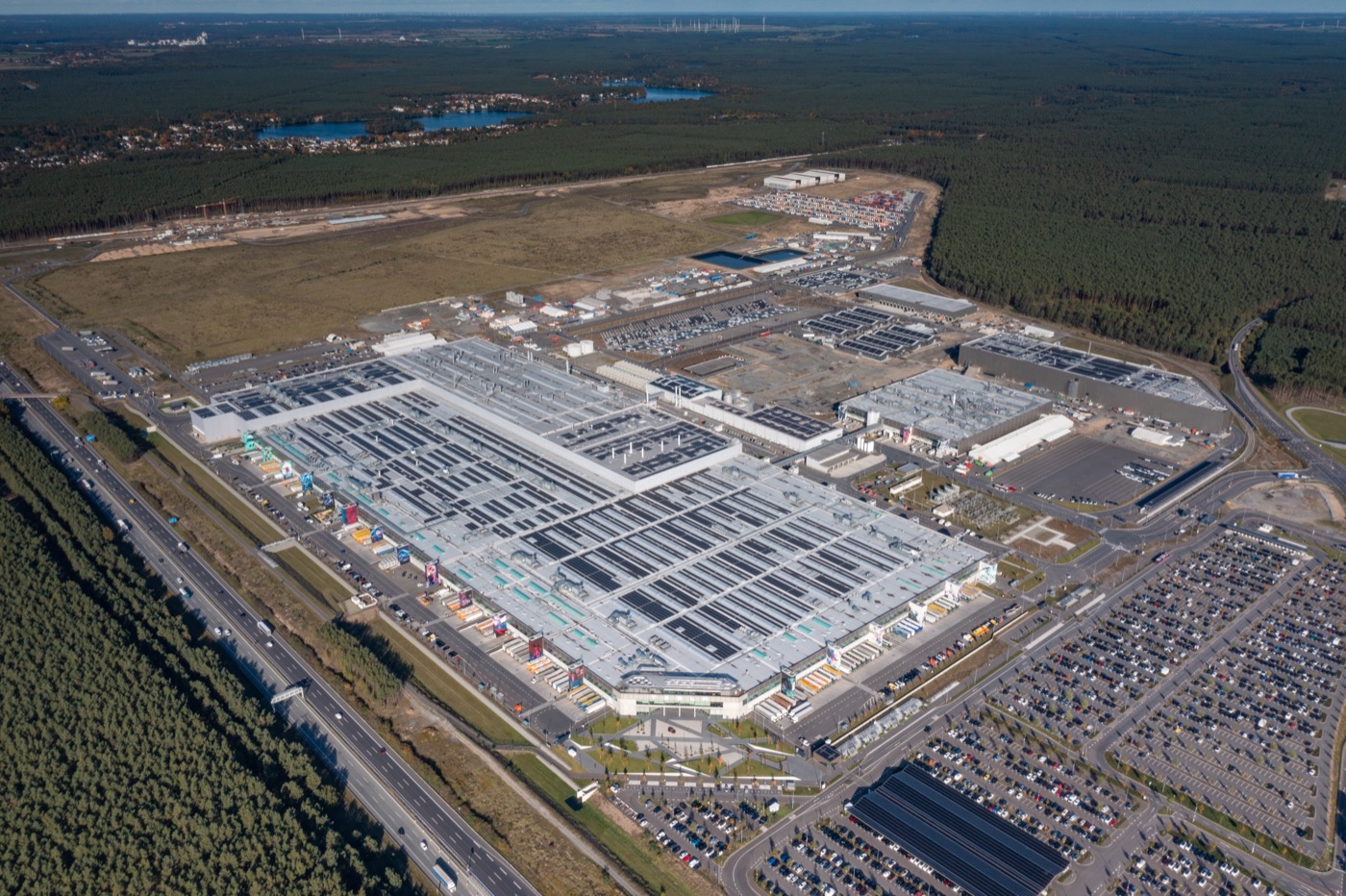
Image: Wikimedia Commons / CC BY-SA 4.0.
| KPI | Value | Notes |
|---|---|---|
| FY2025 Revenue | $94.83B · YoY -2.9% | FY2024: $97.69B · FY2023: $96.77B |
| Net income (GAAP) | $3.79B · YoY -46.5% | FY24 $7.09B · tax rate 20% → 27% |
| Blended gross margin | 18.0% · +10 bps | Auto 17.8% · Energy 29.8% |
| Deliveries | 1.64M · -5% YoY | Production 1.66M · Model 3/Y ~95% of mix |
| Energy-storage deployments | 46.7 GWh · YoY +113% | Shanghai Megafactory ramp |
| Operating cash flow | $14.75B · -1.2% YoY | Capex $8.53B · FCF $6.22B |
| Cash + investments | $44.06B · +$7.50B YoY | Interest-bearing debt $8.18B · net cash $35.88B |
| Diluted EPS | $1.08 · FY24 $2.04 | Diluted shares 3.528B |
FY2025 marks only the second year in Tesla’s history with a full-year revenue decline. Vehicle volumes fell 8%, ASPs slipped, and regulatory-credit revenue dropped from $2.76B to $1.99B, pulling GAAP net income from $7.09B down to $3.79B. The offsetting force comes from energy storage — deployments doubled to 46.7 GWh and gross margin spiked to 29.8% — alongside the Robotaxi launch in Austin in June. The market is repricing a company whose identity is shifting from auto OEM to AI / energy / autonomy platform.
— Synthesis of 10-K / 10-Q disclosures; data not independently audited
§02 · Business — revenue, geography, deliveries
Revenue mix · three segments
Auto (sales + credits + leasing) is still the bulk at 73.3% ($69.5B); but energy-storage growth at 27% YoY makes it the engine of the franchise — against falling top-line, energy delivered $2.69B of incremental revenue, offsetting $7.54B of decline in auto. Services & other ($12.5B) is built on Supercharging, paid charging, insurance, and used vehicles, +19% YoY.
Auto segment · internal split
Regulatory-credit revenue dropped from $2.76B to $1.99B (-28%) — the OBBBA (One Big Beautiful Bill Act) curtailed certain federal credit programs tied to Tesla products. Because this revenue is essentially 100% gross margin, its decline directly bites into Tesla’s operating profit.
Geographic split · sales location
United States $47.6B (50.2%) · China $21.0B (22.1%) · Other $26.2B (27.7%). China was largely flat, while other international markets were down $2.78B. The US held steady, primarily because Megapack and storage offset weaker delivery volumes.
Auto gross margin · ex-credits
Reported auto gross margin slipped from 18.4% in FY24 to 17.8%; but stripping out regulatory credits, the “true” manufacturing gross margin has stalled for two consecutive years at ~15.4% — i.e. scale economics and cost-down on the core auto business have plateaued, and have not absorbed the combined pressure of falling ASPs and rising tariffs.
Quarterly revenue & YoY growth
§03 · P&L — margin compression 2025
Income statement (quarterly + FY)
Per SEC disclosure · USD millions.
| Item | Q2 25 | Q3 25 | Q4 25* | FY 25 | FY 24 |
|---|---|---|---|---|---|
| Revenue | 22,496 | 28,095 | 24,901 | 94,827 | 97,690 |
| › Automotive sales | 15,787 | 20,359 | 16,750 | 65,821 | 72,480 |
| › Regulatory credits | 439 | 417 | 542 | 1,993 | 2,763 |
| › Automotive leasing | 435 | 429 | 401 | 1,712 | 1,827 |
| › Energy generation & storage | 2,789 | 3,415 | 3,837 | 12,771 | 10,086 |
| › Services & other | 3,046 | 3,475 | 3,371 | 12,530 | 10,534 |
| Cost of revenue | 18,586 | 23,041 | 19,892 | 77,733 | 80,240 |
| Gross profit | 3,910 | 5,054 | 5,009 | 17,094 | 17,450 |
| R&D | 1,589 | 1,630 | 1,783 | 6,411 | 4,540 |
| SG&A | 1,366 | 1,562 | 1,655 | 5,834 | 5,150 |
| Restructuring & other | 0 | 238 | 162 | 494 | 684 |
| Operating income | 923 | 1,624 | 1,409 | 4,355 | 7,076 |
| Net income (GAAP) | 1,172 | 1,373 | 840 | 3,794 | 7,091 |
| Diluted EPS | $0.33 | $0.39 | $0.24 | $1.08 | $2.04 |
* Q4 2025 derived from FY2025 less 9M 2025 (Q3 10-Q); not separately disclosed. Q1 can be derived from 9M minus Q2-Q3; omitted for brevity.
Segment gross margin
Energy-storage gross margin expanded for two consecutive years from 18.9% in FY23 to 29.8% in FY25 — driven by scale from Shanghai Megafactory volume production and falling raw-material costs. Auto gross margin continued to compress: 17.8% is approaching legacy OEM levels.
Delivery mix · Model 3/Y absolutely dominant
FY2025 ~1.64M deliveries · estimated by model.
Delivery mix · by model
The 10-K does not disclose model-level numbers, only total production of 1.66M and total deliveries of 1.64M. Based on Tesla’s typical quarterly operational updates, Model 3/Y account for roughly 95% (~1.56M); Model S/X + Cybertruck combined ~5% (~80k).
The Cybertruck ramp is materially behind plan — management acknowledges in the 10-K that “Cybertruck capacity has not matched demand.” Of restructuring expense, $390M came from the H2 2025 AI chip-design consolidation and the “supercomputing-asset impairments, contract terminations, and employee separations.”
Robotaxi launched in Austin in June 2025 using existing Model Y vehicles; the dedicated Cybercab is still in volume-production preparation. On the energy side, Megapack and Powerwall remain the workhorses, with a new residential solar panel introduced in 2025 and first deliveries in January 2026.
§04 · Balance — net-cash $35.9B
Three-period balance sheet comparison
6/30 · 9/30 · 12/31 2025 · USD millions.
| Item | Jun 30 | Sep 30 | Dec 31 |
|---|---|---|---|
| Cash & equivalents | 15,587 | 18,289 | 16,513 |
| Short-term investments | 21,195 | 23,358 | 27,546 |
| Accounts receivable | 3,838 | — | 4,576 |
| Inventory | 14,570 | — | 12,392 |
| Total current assets | 61,133 | 64,653 | 68,642 |
| PP&E, net | 38,574 | — | 40,643 |
| Digital assets (BTC) | — | — | 1,008 |
| Total assets | 127,955 | 133,735 | 137,806 |
| Short-term debt | — | — | 1,640 |
| Long-term debt | — | — | 6,736 |
| Total liabilities | 50,495 | 53,019 | 54,941 |
| Retained earnings | 36,399 | 37,772 | 39,003 |
| Stockholders’ equity (parent) | 77,314 | 79,970 | 82,137 |
The Q3 10-Q comparison table only discloses point-in-time totals; certain line items shown as of Dec 31.
Cash + short-term investments · stack
By year-end 2025, cash + short-term investments reached $44.06B, $7.50B higher than year-end 2024. Interest-bearing debt of $8.18B (current portion $1.58B, including the China Working Capital Facility) leaves net cash of about $35.88B.
Capital structure · single-class common
No Class A/B dual class, but Musk’s stake is concentrated. As of 2025-12-31, common shares outstanding were 3.751B (a net increase of 535M from 3.216B at year-end 2024, primarily from the 96M-share 2025 CEO Interim Award and 423.7M-share 2025 CEO Performance Award). No Class A/B dual-class structure; under NASDAQ rules, the company does not qualify as a “controlled company” either.
| Class | Shares | Voting share |
|---|---|---|
| Common Stock (1 vote) | 3.751B | 100% |
| Elon Musk · direct + indirect | ~13% | ~13% |
Assets vs liabilities · structure
§05 · Cash Flow — cash, not accounting
OCF / Capex / FCF / SBC · annual comparison
Cash flow takeaways
- OCF essentially flat. FY25 $14.75B vs FY24 $14.92B (-1.2%); revenue declined but operating cash flow held — driven by inventory turnover improvement and a longer payables runway.
- Capex stepped down by $2.82B. $8.53B vs $11.34B prior year (-25%) as Phase-1 spend on AI/compute infrastructure largely completed. 2026 guide: Capex > $20B for AI compute, new vehicle expansion, and Robotaxi infrastructure.
- FCF $6.22B · positive but narrowing. FCF/net income ~1.6×; lower Capex pushed FCF above FY24’s $3.58B. But if the 2026 Capex guide lands, the company will see a materially negative FCF print.
- SBC stepped up to $2.83B. The 2025 CEO Performance Award has not yet begun heavy amortization — as of 2025-12-31, the unrecognized SBC tied to that award is $10.23B, to be recognized over 9.7 years.
§06 · Leadership — who’s running this
Named Executive Officers & Board
The following are the executives and directors who signed the FY2025 10-K on 2026-01-28. Two material governance events during the period: 1) on August 3 the board approved the 96M-share 2025 CEO Interim Award; 2) on November 6 shareholders approved the 2025 CEO Performance Award — about 423.7M shares across 12 tranches tied to market-cap and operating milestones, escalating to a $8.5T market-cap target. Tesla redomiciled from Delaware to Texas on 2024-06-13; the related derivative litigation around the “2018 CEO Performance Award compensation suit” in the Delaware Chancery was dismissed via settlement on 2025-04-25.
| Role | Name | Notes |
|---|---|---|
| CEO · Co-founder | Elon Musk | Technoking of Tesla · Chief Executive Officer · Director. CEO since 2008. Direct + indirect ownership ~13%. In 2025 received approval of the CEO Interim Award (96M shares) + CEO Performance Award (~424M shares / 12 tranches); fully vested, the underlying market-cap targets escalate to $8.5T. Concurrently runs SpaceX, xAI, Neuralink, and Boring Company. |
| CFO | Vaibhav Taneja | Chief Financial Officer (also Principal Accounting Officer). CFO since August 2023, succeeding Zachary Kirkhorn. Indian-American; joined Tesla via the SolarCity merger in 2017, previously serving as Corporate Controller. Concurrently Principal Accounting Officer, with signing responsibility for SEC reports. |
| Chair · Independent | Robyn Denholm | Chair of the Board · Independent Director. Replaced Musk as Chair in November 2018 (terms of the SEC settlement). Previously CFO of Juniper Networks and CFO/COO of Telstra. Pivotal supporter of both Musk mega-comp packages. |
| Co-founder · Director | JB Straubel | Co-founder · Director. Former CTO (2004-2019). After leaving in 2019 founded Redwood Materials (battery recycling). Returned to the board in 2023; among the most technically grounded non-executive directors. |
Governance milestones · 2025
Q2 2025 – FY2025 · 10-Q / 10-K / 8-K disclosures.
- 2025-06. Robotaxi service formally launched in Austin using own Model Y vehicles.
- 2025-08-03. Board grants Musk 96M shares under the 2025 CEO Interim Award (2-year vesting, strike $23.34/share).
- 2025-09-03. Approximately 423.7M shares granted under the 2025 CEO Performance Award (accounting service period of 9.7 years).
- 2025-11-06. Shareholder meeting approves the 2025 CEO Performance Award by majority vote.
- 2026-01. 10-K Item 9B disclosure: in January, Tesla signed a minority equity investment agreement with xAI; amount undisclosed.
Board of Directors
9 directors · 2026-01-28 10-K signature page.
| Director | Role |
|---|---|
| Robyn Denholm | Chair · Indep |
| Elon Musk | CEO · Director |
| Ira Ehrenpreis | Director |
| Joseph Gebbia | Director |
| Jack Hartung | Director |
| James Murdoch | Director |
| Kimbal Musk | Director |
| JB Straubel | Director · Co-founder |
| Kathleen Wilson-Thompson | Director |
Of 9 directors, 2 are direct relatives of Musk (Elon + Kimbal); Ira Ehrenpreis is a long-time Musk associate, and Joseph Gebbia is also closely connected. Even so, with the Texas redomicile complete, the new protections under Texas Business Organizations Code §21.606 strengthen the anti-takeover regime — substantially reducing the probability of “comp-package opposition” stockholder litigation.
§07 · Risk — what could derail this
- Elon Musk attention split & key-person risk. 10-K Item 1A explicitly flags this as a material risk: “We are highly dependent on the services of Elon Musk” — who concurrently runs SpaceX, xAI, Neuralink, Boring Company, and X Corp., and is not full-time at Tesla. In 2025 a new minority investment in xAI further widened related-party exposure.
- CEO compensation execution and dilution. The 2025 CEO Performance Award totals ~424M shares, ~11.3% of FY2025 year-end shares outstanding (3.751B). Full vesting implies $10.23B unrecognized SBC (treated as highly probable) plus $86B of “low-probability” unrecognized expense. If milestones accelerate, GAAP EPS will dilute further.
- Cybertruck ramp and product cycle. Cybertruck has not reached planned volume; in H2 2025 Tesla recorded $390M of restructuring expense tied to AD-segment chip-design consolidation. Meanwhile, the planned introduction of a “next-gen low-cost platform” and Cybercab volume in 2026 all depend on Gigafactory Texas and the next-generation cell. Ramp risk is concentrated.
- Regulation and tariffs · OBBBA / trade policy. OBBBA has eliminated/limited EV tax credits and ZEV credit programs → the direct cause of regulatory-credit revenue -28%. Higher US tariffs on China have raised Megapack raw-material costs, and especially the energy segment (“the 10-K explicitly notes tariffs hit Energy harder than Auto”). FX exposure for the China factory and European market is intensified.
- FSD / Robotaxi / autonomous-driving rules. Robotaxi launched in Austin 2025-06, currently relying on Model Y. NHTSA’s SGO (Standing General Order) requires all autonomous-system crash events to be reported, and the regulatory regime is fragmented (state + federal), which could slow expansion. A single major incident or FSD lawsuit could upend the service rollout.
Bottom line · Auto margins have bottomed, beta pivots toward AI & energy.
The core signal of FY2025: the auto business has largely exhausted its “cost dividend” — the core auto gross margin (ex-credits) has stalled at ~15.4% for two consecutive years. Three variables determine the next leg of the valuation re-rating:
- Whether Robotaxi can expand beyond Austin in 2026
- Whether energy-storage gross margin can hold ≥28%, plus Megapack share
- Whether Musk’s tranche-1 market-cap milestone ($2T) triggers
- The FCF curve once 2026 Capex steps up to $20B+
“$44B cash · net cash $36B · Robotaxi already live” — downside protection is ample, but the growth story needs delivery on the AI/energy side.
§08 · Valuation — valuation in context
TSLA current valuation
Data as of 2026-04-20 · close.
| Metric | Value |
|---|---|
| Price | $401.09 |
| Market cap | $1.51T |
| P/E (TTM) | 372.3× |
| P/S (TTM) | 14.9× |
| EV/EBITDA | 136.2× |
| FCF Yield | 0.5% |
| 52W range | $222.79 – $498.83 |
Based on FY2025 net income of $3.79B and 3.75B diluted shares (EPS $1.08), the implied P/E is well above the auto peer set; FCF Yield <1% indicates the market is assigning the dominant weight to the future Robotaxi / energy / AI story.
Peer benchmark
Auto OEMs · TTM · 2026-04-20 latest.
| Ticker | Price | Mkt cap | P/E | P/S | EV/EBITDA | FCF Yield |
|---|---|---|---|---|---|---|
| TSLA | $401.09 | $1.51T | 372.3× | 14.9× | 136.2× | 0.5% |
| F | $12.87 | $51.6B | 11.1× | 0.3× | 34.0× | 6.8% |
| GM | $81.32 | $75.9B | 24.6× | 0.8× | 10.0× | N/M |
| RIVN | $17.32 | $21.4B | N/M | 3.4× | N/M | N/M |
TSLA’s P/S of 14.9× is 18-50× that of F/GM, and ~4× new-entrant RIVN; EV/EBITDA at 136× sits between GM 10× and F 34× — the market is no longer pricing Tesla as a “volume OEM.”
Versus legacy automakers (F, GM), TSLA commands an order-of-magnitude premium — its P/E is ~15× GM’s, its P/S nearly 50× Ford’s — this is not “auto-business” pricing, but the market’s combined bet on three narrative strands: Robotaxi at scale / sustainable energy-storage margin / monetizable AI compute assets. Versus EV-pure RIVN (P/S 3.4×, P/E and EV/EBITDA both N/M), TSLA’s absolute multiples remain higher, but TSLA is profitable and carries $36B of net-cash cushion, while RIVN is still in cash-burn mode. An FCF Yield of just 0.5% means by today’s free cash flow alone, TSLA has almost no “intrinsic-value” cushion: if the 2026 Capex $20B+ guide lands, near-term FCF likely turns negative, and the multiple will rely even more on milestone narrative — not on discounted cash flow — to hold up.
— TSLA data: stockanalysis.com · peers: Yahoo Finance / StockAnalysis / GuruFocus 2026-04